
Annapurna Trekking Region
Annapurna – a mountain range synonymous with Nepal but exactly where is it,
how do you get there, and is the trekking any good?
The Annapurna Massif is a spectacular trekking region suitable for all age abilities, experience, and challenges. It has a myriad of flexible routes, classic rural villages, and thick forests, all within sight of towering white peaks Nepal is famous for. As the trekking altitudes are predominantly below 3500m, it reduces the risk of altitude sickness enormously, making this region a very attractive place to trek for those who do not seek the harsher conditions of the Everest side.
For first-timers to Nepal, families, those who are not perhaps drawn by Everest, or those who want a trek of around 5 days, I would strongly recommend the Annapurna trekking region.
Skip straight to trekking options.
Where is Annapurna?
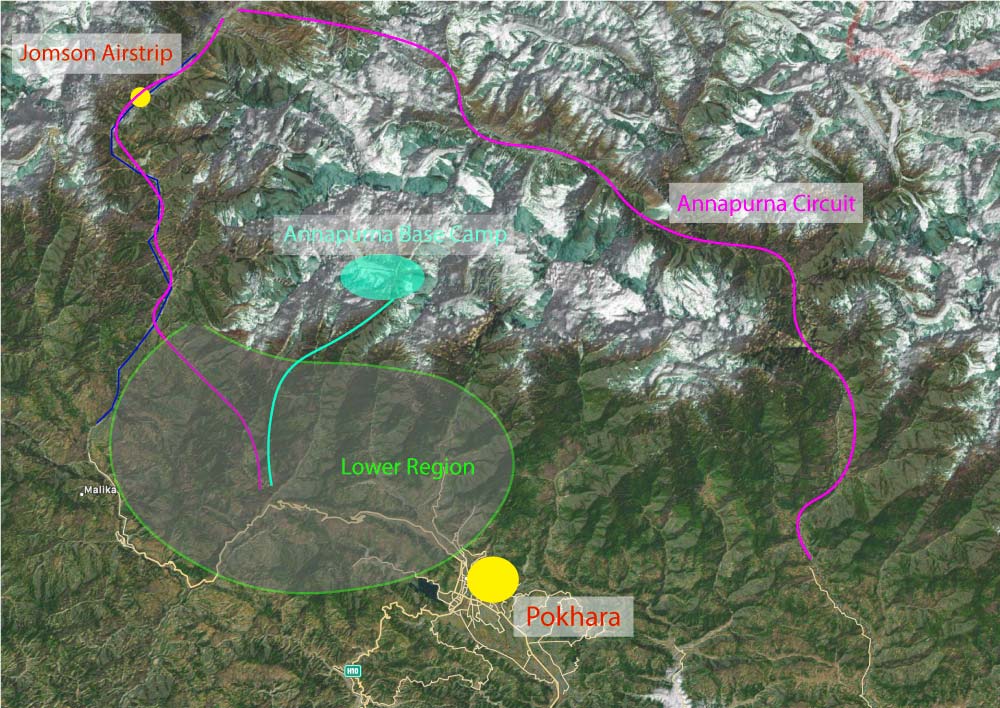
The Annapurna trekking region is 200km to the west of Kathmandu, in the opposite direction to the Everest region. Its northern border is effectively Tibet (China) and its western side is marked by the Kali Gandaki river gorge, the deepest river gorge in the world.
Given its location, how you get there (road/air), and any trekking you do, combined with a few days in the wonderful lakeside town of Pokhara, it is going to provide a comprehensive experience of Nepal.

Click image to enlarge
How to get to Annapurna?
Getting to, and into the region is going to involve either a drive, or a domestic flight, or both. This will depend on exactly where you’re going.
The vast majority of travellers will enter Nepal through Kathmandu. From there it is an approx 6 hr drive along Nepal’s main ‘Prithi Highway’ to Pokhara (Nepal’s second-largest city). This is an experience in itself, sit back and enjoy the ride! From here, it’s another 45 – 90 min drive to access the trekking area. 4×4’s and small buses can access deep into the region now as shown on the map below. They are slow bumpy journeys.
Domestic flights take just 30 mins from Kathmandu – Pokhara, and from there you’ll need to drive into the Annapurna Region, again depending on where you want to go. The exception is another 20 min domestic flight from Pokhara to the mountain airstrip of Jomson. This is a spectacular flight.

Click image to enlarge
The Scale of Annapurna Trekking
I would suggest the Annapurna trekking region has more trekking options than any other region in Nepal. It hosts two renowned world-class treks: the Annapurna Circuit and Annapurna Base Camp treks. The former is in excess of 10 days.
All of the shorter treks are in the southern area and can be anywhere between 2-3 days upwards, depending on your wishes. See some options further down.
This is no minnow of an area. It hosts 1 x 8091m peak (Annapurna 1, the 10th highest in the world), 13 x 7000m peaks, and 16 x 6000m peaks as well as the world’s deepest river gorge (Kali Gandaki), so any notion you’ll miss out on some spectacular mountain scenery should immediately be dismissed!
Click image to enlarge
Am I fit enough for Annapurna?
Many people think all Nepal treks are extreme, high altitude, too severe, and beyond them. It is not true. The Annapurna trekking region, particularly the lower region, suits a whole range of abilities. The trekking needs to be done of course but it’s certainly not extreme.
If you want a direct comparison, try our Everest Base Camp vs Annapurna Base Camp article. As an overall trekking experience (and one of Nepal in general), I would favour Annapurna over Everest and I know both areas pretty well.
Am I fit Enough? – My simple rule of thumb is this … If you go for a long walk (say 6 hrs in total including natural rest stops) in one of the UK’s National Parks (eg, Peak or Lake Districts), over undulating terrain carrying a daysack weighing around 6kg and you can get up next day and do it all over again, I would suggest you are more than capable of completing treks in the Annapurna area. Sometimes it is more about perception than capability.
Some Annapurna Trekking Options
Below are some trekking route options, based on time alone. Routes are adjustable and therefore so is the time spent on trek.
Lower Annapurna (3 – 6 days)
This great area can host a varied set of treks ranging 3 – 6, or even 7 days. A loop is preferable for most, and that will include Poon Hill (3210m), which is a fantastic photographic hotspot for sunrises. Trekking-wise, Poon Hill is as high as it gets around this area. An excellent area for first-time trekkers, families, and short treks but even for more experienced trekkers, don’t underestimate its beauty and welcoming mountain hamlets.
Annapurna Base Camp (6 days)
This trek is also known as the Annapurna Sanctuary trek. The shortest and simplest itinerary takes just 6 days with 5 of those days trekking up and back down the gully that leads to/from the Annapurna Base Camp. That up-and-down route can’t be avoided or changed but you can adjust the route beyond that (from Chhomrong).
The trek up to the Annapurna Base Camp can be physically demanding in places but like any ascent, taken at your own pace, it’s manageable. The base camp itself is a glorious amphitheater of towering snow-capped peaks. At 4130m, it’s possible the altitude may cause some discomfort but any serious cases are easily remedied by descending to a slightly lower altitude.
Changes to Annapurna Trekking
It’s fair to say that there have been significant changes along the trekking routes over the past decade. Dirt tracks (capable of carrying 4×4’s and small buses) have been built to aid development and supply to local villages, at the expense of the original trekking trails. But new trails, away from the dirt tracks have also been developed to reinstate the status quo.
The original Annapurna Circuit has been the main victim, with just a few days of the original route (over the Thorong La Pass) left.
Tracks have also creeped into the lower region. Ghandruk is reachable, so too beyond Landruk, and Ghorepani is not far behind.
All that said, there are more than enough routes to satisfy the purists that like to trek along remote, mountain trails without a sniff of a vehicle.
Annapurna Circuit (Mini) (10 days)
What can I say about the Annapurna Circuit. A historical classic. In its original form, some 15 – 20 years ago, it was a fantastic 3-week experience. Inexperienced trekkers could immerse themselves into the Circuit, sleeping in tea houses along the way, carrying very little. It was a carefree, unhurried and beautiful way to spend time. Perhaps surprisingly, nearly all of the route is under 3500m in altitude. Only the 3-day hop, skip and jump over the Thorung La Pass is higher but given that Pass is at 5416m, it was some ‘skip’! It is an element of the Circuit that is grossly underestimated by many, as the 2014 freak storm sadly demonstrated. At least 21 people died due to that storm.
The most common starting point is now Jagat, but you can progress as far as you like on the 4×4 dirt track toward Manang. The only word of warning is acclimatisation. It is wise to approach Manang for a number of days on foot to allow acclimatisation to take place.
The Emergence Of The Mini Circuit. The trek leading into Manang, over the Thorong La Pass, and down to Jomson (at least) still makes for a formidable challenge, and extremely rewarding. The change in scenery from a lush valley, through potential snow at high altitude, and down to a high altitude desert is amazing, as is the culture change too. The Manang side is predominantly Hindu, whereas the Jomson side is Tibetan/Buddhist.
Flexibility
Other examples of how you can tailor-make your trek to suit your time, challenge, and enjoyment:
- Fly into Jomson, explore Muktinath and Kagbeni, and then trek south along the Kali Gandaki
- Shorten the ABC trek by 3-4 days, by exiting through Ghandruk (missing Poon Hill)
- Do the Annapurna Mini Circuit, 4×4 jeep from Jomson – Tatopani, and then trek up to Ghorepani, see Poon Hill. Creates a longer trek
- Create a clockwise circuit from Ghandruk – Poon Hill, back through Chomrung, out through Landruk
- Trek for 4-5 days in the lower region, go back to Pokhara for 2-3 nights, fly to Jomson, spend 2 – 3 days exploring that area, fly back to Pokhara.
Let us help you create your own bespoke itinerary, call Terry: 07725 943108, or email us directly.
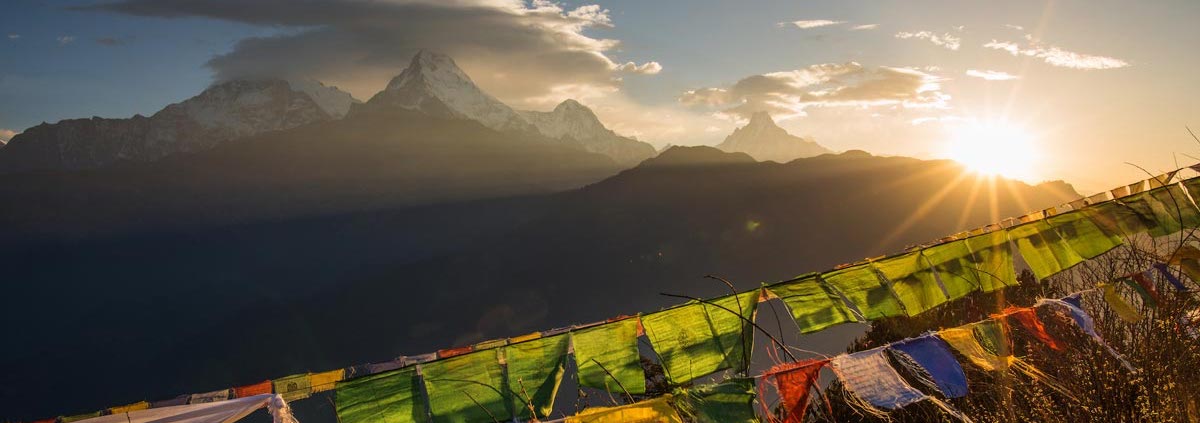
No matter where you are in the Annapurnas or Pokhara, you will see and hear things about Poon Hill. This 3200m hilltop is a short 30 – 45 min ascent from Ghorepani. Its location makes it special, sat between the two mountain ranges of the Annapurnas (to the east) and the Dhaulagiri range (to the west). Both mountain ranges have 8000m+ peaks in them. Poon Hill is sat perfectly to witness the sun rising over the Annapurnas, the sunlight first hitting the Dhaulagiri range before you actually see it rise.
Pokhara
Post trek, the town of Pokhara awaits. This is an excellent relaxing place to rest and recover from the trek. It has lots of atmosphere in the numerous cafes, bars, and restaurants or you can fill your time with more adventure. It certainly lends itself to extending your time in Pokhara.
At the completion of almost any trek in the Annapurna region, Pokhara is no more than a 90 min drive (Naya Pul), or a 20 min flight from Jomson plus a short airport transfer.
The variety of hotels we use are of good quality and never more than 10 mins walk to the centre of town, usually less. Most of our itineraries spend 2 nights here, realistically giving you one and half days of downtime. You could easily extend that to really relax and unwind prior to flying back to Kathmandu (recommended).
What To Do? Stroll around the town, and mooch in the many cafes, bars, and restaurants, try a day whitewater rafting, world-class paragliding, world-class microliting, some mountain biking, try bungee jumping or a 1.8km zip wire (one of the longest in the world).
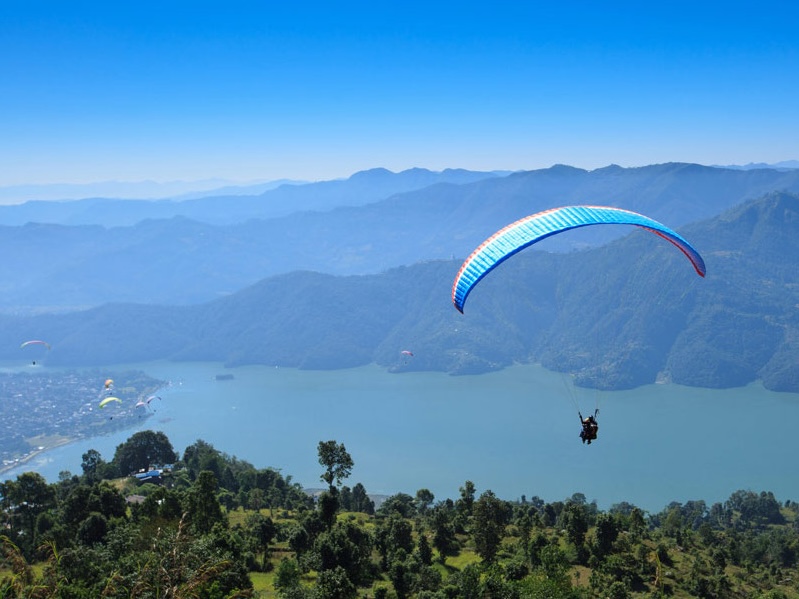
Pokhara – great place to chill out.
Summary
I can’t recommend this region highly enough if you want an all-encompassing experience of Nepal. Short, low, long, high, challenging or otherwise, the Annapurna Region has it all. It suits couples, small groups, families, and charity groups alike looking to enjoy the magnificent scenery and rural village community spirit.
To have Pokhara too is a real bonus. If you drive there, fly back, you get to see it all from the ground as well as from the air.
Our Reviews
Pokhara – What To Do & See

Everest Base Camp Review

Kilimanjaro vs EBC | Treks Compared | Which is Harder

Is The Maldives Worth It?


