
How Hard Is Kilimanjaro?
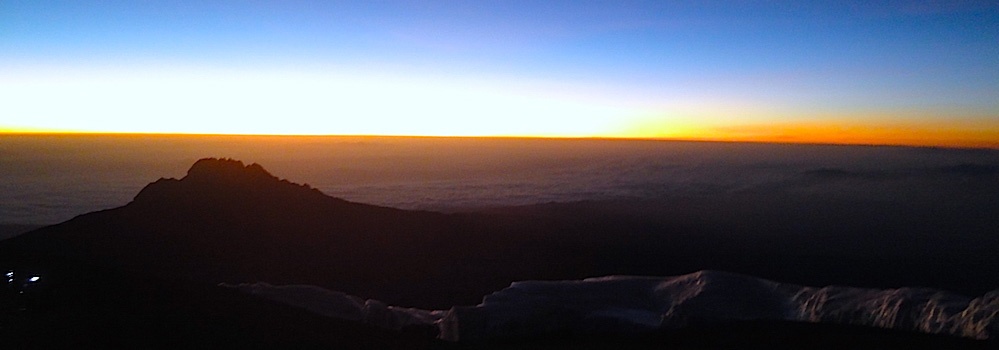
‘How hard is Kilimanjaro?’ – A question so often asked.
Kilimanjaro is a beast of a mountain and summit success should not be taken for granted.
Its altitude alone demands serious respect but there are many other factors.
Kilimanjaro Facts
- It is a 3-mile vertical climb.
- There are 5 different climatic zones from Bushland to the Arctic.
- The ascent to the summit: 6 – 7 hrs, a 1300m – 1400m ascent, it’s dark, it’s cold, and it will be below zero on the summit.
- Summit day is over 12 hrs long, including the descent from the summit to the next night’s stop.
- Altitude sickness is a real threat on summit day.
Don’t underestimate just how big Kilimanjaro is. This dormant volcano rises some 5895m (19,341’) out of the ground and is the highest free-standing mountain in the world. It’s around 600m higher than Everest Base Camp and also higher than Mt Toubkal with Ben Nevis perched on top! It sits just 205 miles south of the equator and yet has several small glaciers sitting on the top; further proof of just how high the lofty summit is.

Climatic zones – click to enlarge
Between Moshi (854m, a town at the base of Kilimanjaro) and Kilimanjaro’s summit (5895m), is a tough 3 miles of vertical ascending. 33% of that is climbed on the final ascent. There can be few other places on the planet (if any) to experience the variation in climatic zones as it is here. Anyone reaching the summit will experience all 5. There’s a huge range of temperatures to account for as well as potential rain. Read our useful article on the Layer Clothing System.
There are a number of recognised named routes, and a number of others too where parts of different routes are combined. The 4 routes that we offer are a min of 7 days/6 nights to allow for sufficient acclimatisation. Go to our comprehensive Kilimanjaro webpage for detail, dates, and prices. Kilimanjaro’s weather can be unpredictable so do consider the Rongai route in spring. Approaching from the northern side, this route receives very little rain.
Our Kilimanjaro treks will depart with a min of just 2 people. So, if you want to trek as a couple, perhaps on specific dates of your choosing, you can do just that. Just call us on 07725 943108 or talk to us.

Lemosho, Rongai, Machame, and Northern Circuit.
The 4 routes we offer. Click to enlarge.
Understanding Acclimatisation
Understanding the process of acclimatisation is vital on Kilimanjaro. The simple key to a successful summit is to be in a position where the ascent can be attempted in good form, and that means acclimatisation (see our advice on trekking to high altitude under General Notes on our Kilimanjaro trek page.). That in turn means time on the mountain pre-summit; the more the better. Can you train for high altitude?
As far as Kilimanjaro is concerned, the ‘acclimatisation zone’ lies between 3000m – 4000m. At this altitude, it is the Heath and Moorland climatic region. The low Bushland and Rainforest will have been cleared. As with any mountain, the campsite locations (and therefore their altitudes) are often dictated by the shape of the terrain, not necessarily where the Guides would like them to be altitude-wise.
Why Stop at Karanga?
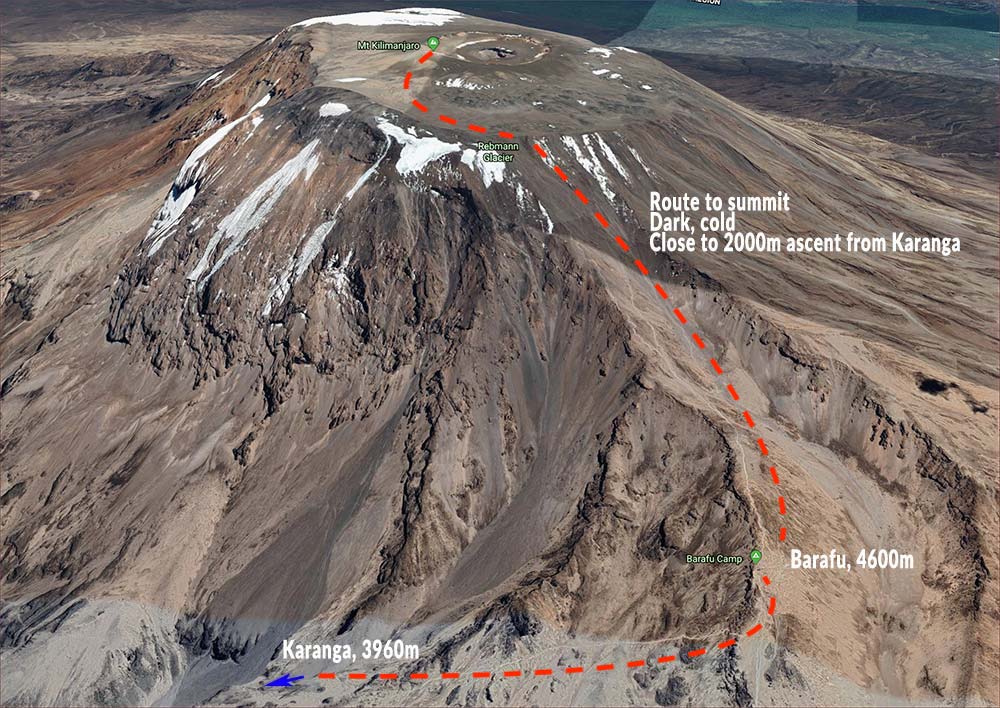
Some trekkers have difficulty understanding why they stop at Karanga. Karanga is on the southern circuit so any route that approaches from the southern side will use it, or pass through it. Time-wise, you can trek quite easily from Barranco to Barafu in a single day (see map). So why stop?
The simple answer is to allow more time to acclimatise.
Even with the stop at Karanga, consider this … whilst it is a short distance to Barafu, it is also a 600m ascent. Having slept at Karanga (3960m), ascended to Barafu, there is just the afternoon/evening before the next ascent (to the summit) begins at around midnight. The time spent at Barafu is quite short but certainly better than nothing at all. So the ascent to the summit effectively starts at Karanga. That’s almost a 2000m ascent. It’s no wonder some people struggle.
If you were to trek from Barranco to Barauf without stopping at Karanga, you compound the issue even further. There would be less rest, and more ascent that day, adding to the already significant ascent that is about to come.
One Shot at the Summit
Ideally, any itinerary to high altitude should have resilience built into it. You need spare days to cover all sorts of situations that may slow you down. Kilimanjaro doesn’t allow for that, for logistical reasons. It’s how the Park works. You get one shot, that’s it. It is a factor that makes Kilimanjaro so hard.
The simple message is not to shortcut that Karanga overnight stop, it is part of the vital acclimatisation process the body needs for a successful summit.
The Summit – Through The Night
The summit attempt is conducted through the night for 2 main reasons. The underfoot conditions are firmer and to witness the sunrise over the earth’s curvature.
The upper reaches of Kilimanjaro can be soft and once you get onto the crater rim, ice and snow may be encountered. The lower temperatures overnight will keep the underfoot conditions firmer, which is much better for walking on.
But trekking through the night brings challenges. Altitude sickness on the final ascent is a real threat. At around midnight, the ascent begins. Everyone will be togged up (it’ll be cold), head torches on. It will take around 6 – 7 hrs to get there. It’s slow progress.
Watch Each Other
Altitude sickness is generally quite apparent in a person’s demeanor BUT that is difficult to see in the dark with only a head torch, whilst ascending and everyone’s tired. Most of the symptoms associated with altitude sickness (fatigue being one) are masked by the fact that you’re climbing so who isn’t going to be fatigued! So it’s down to the Guides and fellow trekkers to pick this up and act accordingly.
It’s not uncommon to see a good number of trekkers on the side of the trail, in a less than healthy way, struggling with the altitude, physically, or both. All of this is underpinned by the fact you’re camping. With the best will in the world, it will wear you down over a week’s trekking particularly if it has been raining at all. It’s difficult to dry stuff.
Final Word
Reaching the summit of Kilimanjaro is immense. It’s the world’s highest free standing mountain and watching that sun rise over the fluffy clouds on the earth’s curvature is something you may never witness again (on your own two feet!). Give the mountain due respect, understand what you’re going into, be well equipped, don’t use short routes, and you too could be standing on top of Kilimanjaro.
“Better to have tried and failed than to have never tried at all” – Sean-Paul Thomas
Go to our Kilimanjaro webpage (4 routes).
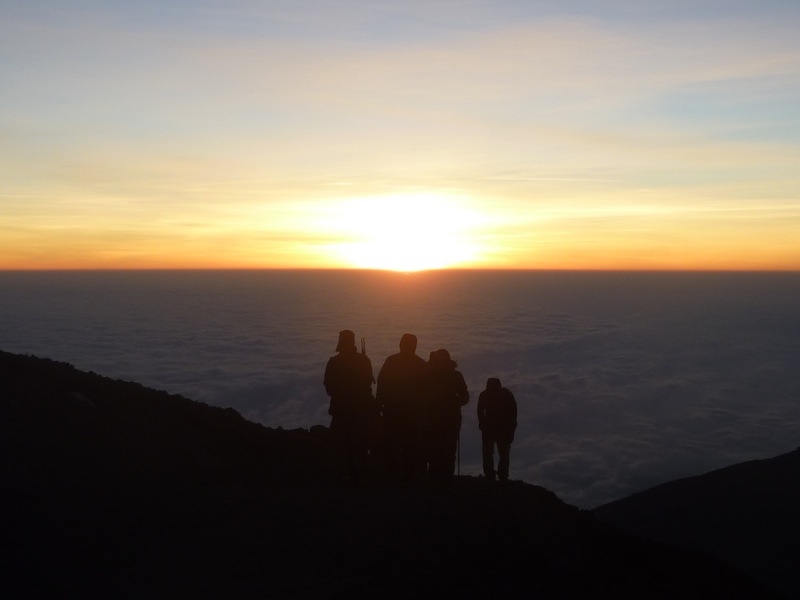
Fantastic feeling – high above the cloud base.
Dawn is breaking over the earth’s curvature.

The traditional wooden signpost marking the summit (Uhuru).
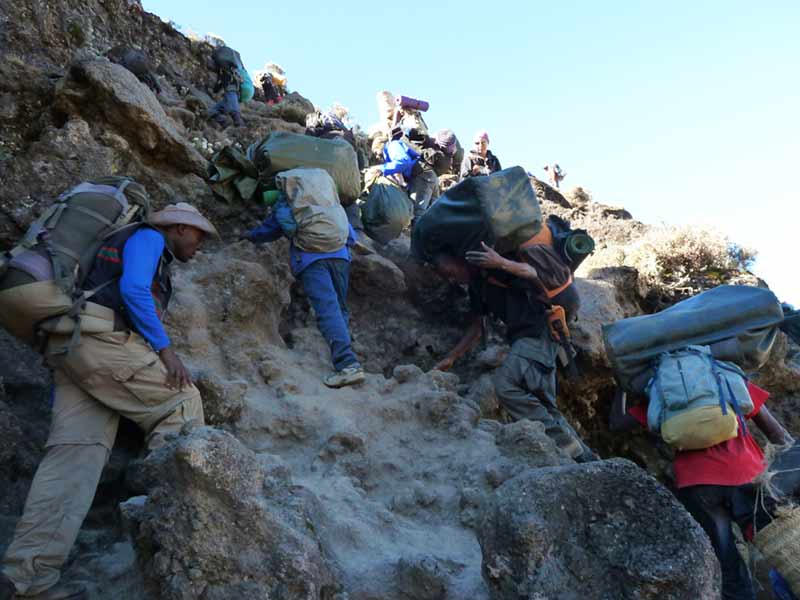
The infamous Barranco Wall.
Our Reviews
Pokhara – What To Do & See

Everest Base Camp Review

Kilimanjaro vs EBC | Treks Compared | Which is Harder

Is The Maldives Worth It?


