
Sahara Desert Trek
A Comprehensive Review
A Comprehensive Review


This comprehensive Sahara Desert review gives you a good insight into what the Sahara Desert trek is all about, including some useful tips.
When you’ve read this trip review, you should go away with some perspective of the difficulty (for you), what to expect accommodation and food-wise, what you need, and where the challenges really lie.
This is a great experience and one that exceeds the expectations of the vast majority of the people that go. Given that the physicality is less than a mountain trek, it suits a wide range of people and can be adapted for families. And the weather makes a difference too! There is also camel support for those that may need it. The real challenge lies in the potential high heat, relatively basic living conditions (although they are still good), and the exposed (very little overhead cover) soft terrain.
Days 1 and 2 – Travel Days
Day 1 – Fly from London to Marrakech, an overnight hotel in Marrakech.
Day 2 – Drive from Marrakech to Ouarzazate. This is a ~5 hr drive, over the beautiful High Atlas mountains, with stops, and shows just how diverse Morocco’s terrain is. You should arrive mid to late afternoon and you may take a diversion to visit Ait Ben Haddou. This UNESCO site is where many films and TV programmes are filmed and well worth seeing. Both the ‘Gladiator’ and parts of ‘Game of Thrones’ were filmed here.
The overnight stop is in a local Riad and once settled in, you should use whatever time you have to re-organise your clothing and equipment ready for the desert tomorrow. Any clothing and equipment that you are not taking into the Sahara desert can be left here (securely stored) until you return. It could be about now that you’re thinking, am I fit enough?
The Weather
With over 300 cloudless days a year, there is a reasonable expectation it will be warm, if not hot. It is after all the Sahara Desert! We tend to go in Mar/Apr and late Sep/Oct to avoid the very hot summer stuff (it would be too hot) and equally to avoid the very chilly nights of the winter months. But even then, we have experienced frost on the tents overnight, or 20°C overnight, sandstorms, heavy rain, and high winds.

Whilst you can rely on warmth, the Sahara weather is not entirely predictable.
If the sun decides to be hot, it can be over 40°C.

A sudden sandstorm, or even light breeze, can reduce visibility drastically
Day 3 – Drive to the Sahara Desert, Start Trekking
There is an air of excitement this morning, as you progress into ‘trek’ mode. Bags will have been re-packed ready for the Sahara Desert and everyone will be dressed accordingly. At breakfast, people suddenly look different; apprehensive, and yet excited.
There is still another ~5hr drive to do, through more spectacular scenery only this time, it soon begins to flatten out and more and more sand appears. There is a scrumptious picnic lunch either en route or when you arrive at the drop-off.
It won’t be until about 30 mins from drop off that you will realise you’re close to the Sahara Desert. So far, what you thought may have been the Sahara, will pale into insignificance when the real desert makes its presence felt.
You will drive through the desert village of M’Hamid, and then the road literally runs out of tarmac and becomes sand. There, to welcome you will be a scaled-back team of camelteers and their camels ready to load your bags (onto the camels) and head off to the first night camp.
Welcome to the Sahara Desert.
Given that you will have been in a predominantly cool air-conditioned environment since leaving home 2 days ago, the change in temperature could be a shock to the system! Be ready for it. In Sep 2019, a charity group stepped into a 40°C+ searing dry heat and within 30 mins, one person required serious assistance and was evacuated the next day. It was an adventure this group will never forget as the soles of footwear literally melted off, and timings were adjusted in order to avoid the sun (very early morning starts).
Your first night’s camp will be 1 – 2 hrs away and a good opportunity to stretch the legs and get used to the new environment. For those not used to camping and all that comes with it, take the time to get used to what’s what and seek help if needed from either your fellow group members of the staff.
The terrain is a little stoney (based on the sand of course) as you cross a river bed within the first kilometer. Once past that and the Palm plantation, the terrain opens up. The dunes will be low level with more vegetation (scrub bushes) than perhaps you were expecting. I prefer boots in this early terrain as the pebbles are big enough to annoy you to death if you wear sandals. You can switch tomorrow. See what works as Sahara footwear.
What’s the Camp like?
The camp will consist of:
- White marquee dining tent, big enough for the group size. This tends to act as a social hub.
- Smaller white marquee tent for the kitchen.
- Numerous 2-3 person sleeping tents, for group members.
- Toilet tent.
On arrival at the campsite, your main bags will be offloaded from the camels and placed in a central place from which you collect it. After the first night, so too will your sleeping tents*. The bottled water will also be here for you to take.
*You will be expected to put up/take down your own sleeping tents. It is the only ‘chore’ expected of you. If you need help, please just ask for it. Tents can vary in design so it is worthwhile ’tagging’ your tent with something easily identified by you, so you get the same tent each night and don’t have to get your head around a different design each time.
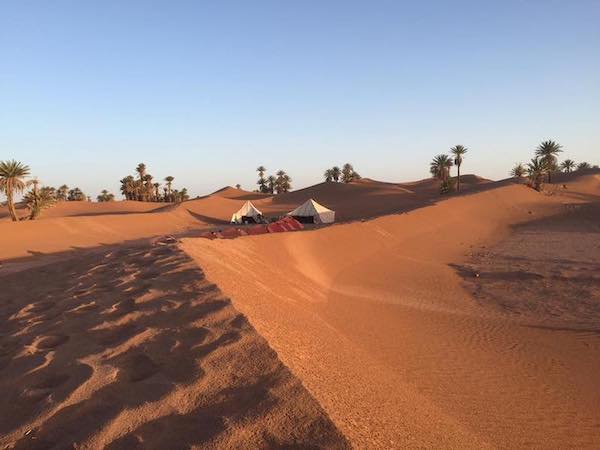
A typical Sahara campsite
Day 4 – First full day of trekking
The weather will dictate what time the Guide plans to start trekking, but 0800hrs is normal. So a 0630hrs wake-up, up, washed and dressed by 0700hrs breakfast is the routine. By breakfast, you really want your tent down and packed as the camelteers will want to sort the loads out for the camels. All of this allows time for a nice leisurely breakfast as the sun rises.
Being the first full day, some will still be undecided about footwear. Boots or sandals? You should be clear of the pebbles by now so I would opt for sandals but I would also carry the boots in case I need to switch for whatever reason. Feet can sometimes take time to settle.
It won’t take long to clear any vegetation, if not already. The dunes will still be relatively low level and you will trek steadily forwards, either over them or around them, until the lunch stop (see ‘the food’ section).
The afternoon will be a shorter session until you reach the night stop, already inhabited by the support team! Having left them behind when you started trekking this morning, they will have miraculously by-passed you and set up camp.
So how do the Guides know where they are?
You can imagine what a map would look like? A sheet of sandpaper. Contours wouldn’t work, the sands are constantly shifting. It’s down to experience and landmarks. What landmarks?? They are subtle, but they are there. The problems can often occur in a sandstorm when visibility reduces to a matter of 10 – 20m. That’s when they earn their money!!
By the time you get to camp, you’ll be tired. Distances are not huge but the combination of the potential heat, soft terrain, and up/down of the dunes will take its toll. But it’s a nice tired. There will be hot drinks and a snack ready for when you arrive, or shortly after.
There’s time to relax, get your tent up, have a good wash, and generally chill out until dinner time around 1900hrs.
Picture this … you are now some distance from civilisation, in a desert. There is no-one else about. No sounds, no ambient light, no roads, no people, just sand. There is no-one else to worry about, no cooking to do, just you. You can sit on the highest dune around, dig your bare feet into the deep warm sand and just watch, think and do nothing. And once the sun is down, the skies fill with millions of stars. Bliss, and it will make you smile. Raw nature.
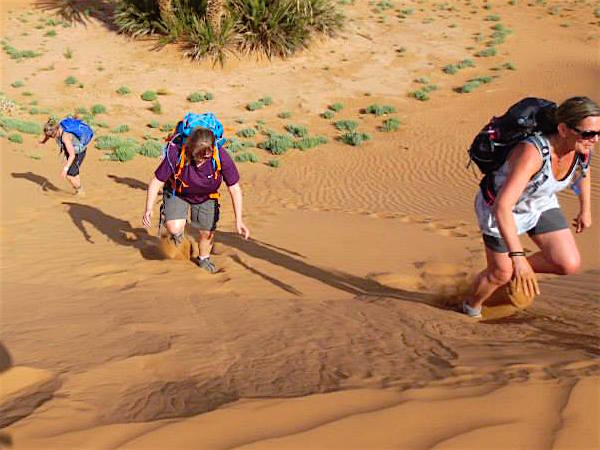
Early days – decide to go over, or around the dunes?
The Sahara sun can be fierce

Sahara ‘shower’ at one of the few water wells in the area
Day 5 – Erg Zaher Day (Eric)
Yesterday, as you approached the night stop, the Guide may have pointed out Erg Zaher in the distance. Erg Zaher (nicknamed Eric) is a huge dune (1900’ above sea level) and the biggest in the area. The night stop tonight will be close to its base from which you’ll climb it in time to see the sunset.
After the usual morning routine, you’ll be on your way, and depending on the progress made yesterday, you’ll get to the night stop at some point from midday onwards. You’ll notice a big change today. Big dunes. Lots of them. And they’re soft and knee-deep.
Soon, it’ll be time to scale Eric. The Guide will ensure you leave on time for it will take about an hour to get to the top. This is not a single dune but an area of numerous dunes so take your time. The final 20 mins or so will be along classic knife-edge ridges, with very soft sand, and at times, you’ll be on hand and knees, it’s that steep. If it was any steeper, the sand would roll down.
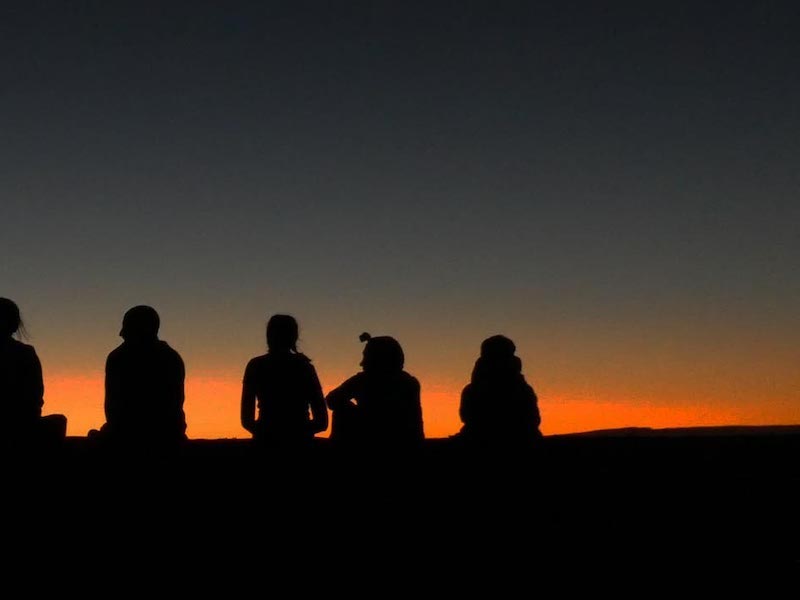
It’s a great feeling reaching the top ridge and once there, settle down and watch that sun dip down below the horizon. It’s a magical moment.
It’s a good idea to take your daysack with some warmer clothing + water + a head torch as it’ll be dark by the time you get back to camp. The dunes all look the same in the dark!

The sun setting from the top of Erg Zaher
What’s the Food like?
‘Stunning’,
‘How on earth do they produce that quality of food out there’
‘never again will I take crap from my chefs’
are just a few comments we have received from clients.
Think about this ….. all food and drinking water, from the outset, is carried by camels for the entire duration of the trek. One, or two chefs (depending on group numbers) has to plan the meals, buy it all and then pack it all on camels, and know where it all is to be able to operate efficiently. And don’t forget this is in potentially high heat, so the storage of food (and what type) is also a factor. They cook on 2 gas stoves.
That in itself is a logistical marvel but when you see the presentation and taste it, you will also wonder how on earth they do it.
Breakfasts – delightfully, this usually takes place outdoors, buffet style. A large mat/blanket is laid out upon which the food and drink is laid out for all to tuck into. Tea, coffee, juice, bread, jams, soft cheese, other spreads, cereals (various, including porridge) and sometimes omelettes. Suffice to say, it’ll fuel you up for the day.
Morning snack – this is not a meal provided but it is as well to be aware of it. During the morning trek, there will be a ‘break’. The Guide often passes round a large bag of mixed nuts, raisins, sultanas and dates for consumption! But this is usually the time to snack on your own reserves of whatever you decided to bring with you for this purpose (pre-planning required!).
Lunch – a mix of hot food (lentils, or soup, both extremely tasty), huge cold salad spreads, with bread and fruit, and hot drinks.
Depending on the day, lunch can be either on the move or at the campsite on arrival. If it’s on the move, a small support team will have gone ahead to set up the lunch stop (dining tent for shade if needed) and will be ready for the group’s arrival. Lunch stops are leisurely affairs, eat, drink, footwear off and generally lie down and relax. A break of a good 90 mins is not uncommon.
Snack on arrival at campsite – hot drinks and biscuits or their version of doughnuts, or similarly welcomed sugary food.
Dinner – a 3-course meal. Soup & bread, followed by the main meal. This can be a tagine but it is generally vegetable/rice/lentil based. You may get chicken on day 1 as they will not be able to store meat. Tinned fruit for desert followed by ‘sleepy tea’ (Chamomile).
Drinking Water
Drinking water is bought in large containers (usually 5 litres) and carried by the camels from the outset. You fill your own bottles on a daily basis. Experience shows that planning for 3 litres of drinking water, per person per day, is about right but rest assure, if we need more, we’ll get it. We will not run dry of drinking water.
You will see other water containers. The water contained in those are for cooking and washing, not drinking.

The presentation of the midday meal (usually salad-based) is just delightful.
Day 6
Another full trek ahead, initially through the big dunes but smiles all round. By now, the whole group will be well and truly into the desert way of life. Footwear, washing, clothing, eating, all honed to suit the way you want it. Any sense of fashion has disappeared as is how you look! You’re in the Sahara desert and all things are relative. This is freedom and it’s great fun.
Two things may happen today:
- Your trek route may pass through one of the few water wells in the area. This is to resupply the washing/cooking water as well as refuel the camels. You may not see this happen but it does.
- Bread making. The bread you eat on a daily basis will run out at some point. So they make some more, either in sand ovens or over a hot ember fire. They make the dough and cook it. Watch it happen, and it tastes so so good!
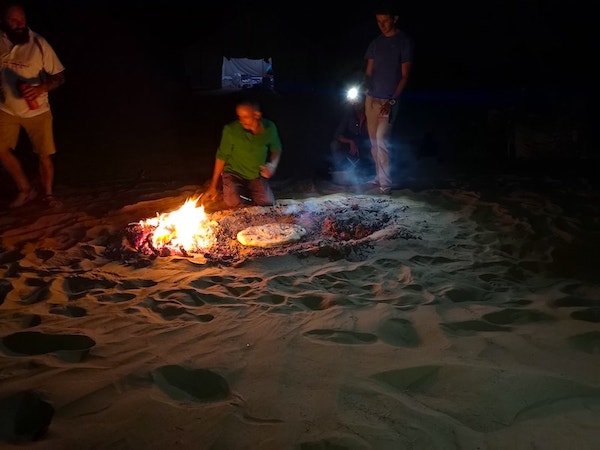
Bread making takes place on about day 4 to replenish supplies.
It tastes sooooo good!
Day 7 – Final trek day
The length of the trek today will depend on how far you travelled yesterday but you should make the pick-up point by lunchtime. It’s time to say goodbye to your wonderful, hardworking support crew, and the Sahara Desert before boarding the minibus and hightailing it back to Ouarzazate.
How do you feel?? Mixed emotions will flow from the elation of finishing the trek to the sadness of leaving the Sahara Desert (or is that just me?), to the thought of a good shower and a bed! The local shops welcome your arrival both en route and in Ouarzazate as the money flows on anything and everything you’ve missed in the past days, although it does seem a lot longer!
Ouarzazate can’t come fast enough. In the shower and what looks like a bronzed body suddenly begins to wash down the drain as you realise some of it is engrained sand! If you’re brave enough, get in the swimming pool (weather dependant). And then let the party begin but please be respectful, Morocco is a Muslim country.
If you think you’d love to do this as a family, read the 5 reasons why you should take your family to the Sahara.
Day 8 – Return to Marrakech
A drive back to the pink city, and all that comes with it. There’s still a lot to do with your time in this intriguing city, whether you wander in the maze of the Medina, relax in the hotel or find a nice restaurant, or even book a Spa.
Day 9 – Return to UK
The Challenges
The obvious ‘challenge’ facing you is the possibility of high temperatures. It can be hot, very hot during the day, and also overnight making it difficult to sleep. This can be debilitating for some. The remaining challenges tend to be a combination of everything else; the ever-present fine sand, minimalistic living in terms of what you have with you, the sheer effort of walking for miles every day over what can be undulating deep sand dunes, sparse living conditions, and toilet facilities, all over a number of consecutive days. It can take its toll. For some, that point comes sooner than others. If you need some inspiration, read how Luisa Pearce did this in a wheelchair.
The good news is that the vast majority get into the Sahara desert ‘groove’. The sooner that can be achieved, or accepted, the better.
- Accept you’ll get grubby.
- Accept any fashion sense will disappear; wear whatever works!
- Accept a lack of communication from the outside world.
- Accept the Sahara desert way of life as quickly as you can and it’ll all be fine!
Summary
The Sahara Desert trek itself may only be 5 days but it will feel much longer than that, such is the experience. It’s a good trek and overall experience and one that will leave you with life-long memories and many friends. Due to its suitability for a wide range of abilities, it tends to exceed most people’s expectations.
The drive across the High Atlas is also a bonus, showcasing Morocco’s vast array of differing terrain. Go well equipped, expect the unexpected and you will have the time of your life.
What are you waiting for …. get across to our Sahara Desert trek webpage and check out the dates, and if you have a preformed group, we can help you select other dates.
Sahara For Families
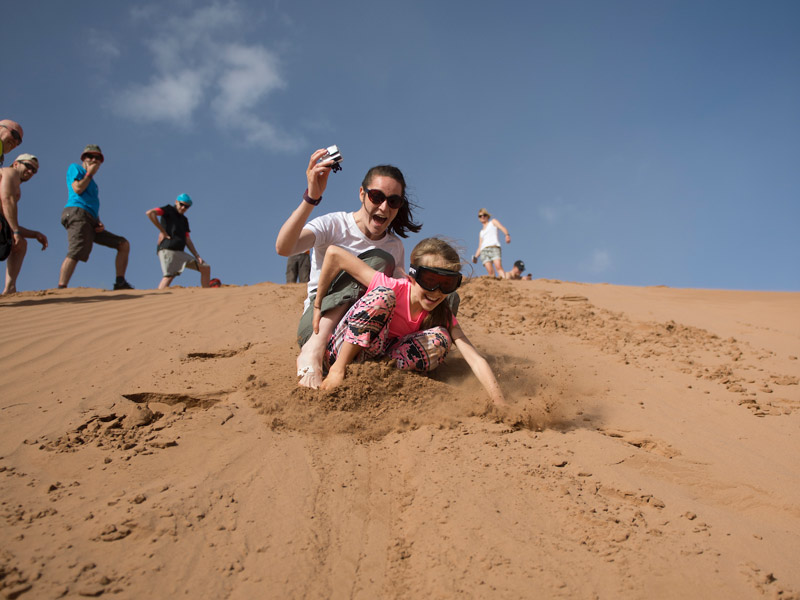
The Sahara Desert trek is purpose-made for a family Sahara adventure. It’s flexible, adaptable, extremely safe with no roads, no people, nothing for miles. What more can youngsters want than a wild adventure, sleeping under the stars in a desert with camels for company!
Go to our Sahara for families webpage.
We are experienced in taking families into the Sahara. We can answer your questions on the familiar subjects that crop up, such as toilets, sleeping, food, the weather, fitness, and what happens if someone gets ill or injured. There are 5 good reasons why you should take your family to the Sahara.
Given that the weather window for trekking in the Sahara is spring and autumn (generally), the school holiday periods of spring half-term, Easter, and autumn half-term are prime times to use. Consider booking early to ensure you get a slot for your family.
Call Terry: 01529 488159/07725 943108, or email us too discuss.
Our Reviews
Pokhara – What To Do & See

Everest Base Camp Review

Kilimanjaro vs EBC | Treks Compared | Which is Harder

Is The Maldives Worth It?


