
Kathmandu – What To Do & See
Kathmandu is not a huge city, at just 19 square miles, it is about a 1/4 size of Amsterdam. Nepal has only one international airport (Tribhuvan). If you are travelling by air, you will arrive here.
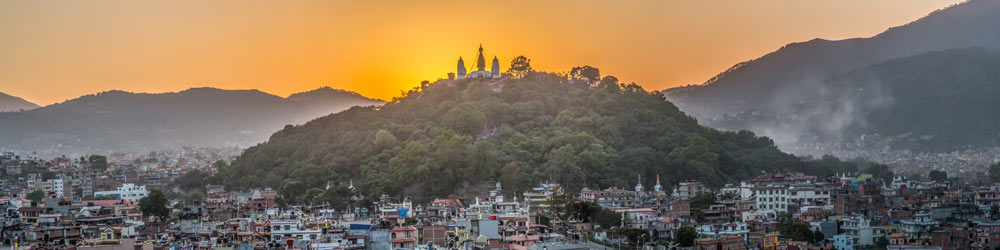
Swayambhunath (Monkey Temple) sticks out like a sore thumb on Kathmandu’s skyline.
This article gives you a flavour, and demonstrates that with a bit of pre-planning, you can see, and do a lot in Kathmandu in a short space of time.
For most travellers to Nepal, Kathmandu is the start and end of their trip. If you are visiting Pokhara too, see our article on what to do in Pokhara. You are, therefore, likely to spend at least 2 nights in this bustling city. Given what you can do and see, the time you have usually passes very quickly. After reading this, you may decide to consider extending your stay in Kathmandu to explore enough to satisfy your wishes.
Best routes to fly UK to Kathmandu.
What To Do In Kathmandu?
Shopping
Thamel is the well-known ‘tourist’ district of Kathmandu. The streets are lined with shops, restaurants and bars of all sorts. You can spend hours wandering the streets, and then again, and again. You will always see something you missed before. If you know your prices (and quality), you can pick up some real bargains here.
Spa Treatments
There are a good number of reputable spa treatment establishments in Thamel. They offer a wide range of beauty and massage treatments at inexpensive rates. If this is something you might consider, it is worth popping in at an early stage as advanced bookings may be required.
Restaurants, Cafes and Bars
In Thamel, you are spoilt for choice when it comes to restaurants, cafes and bars. One stroll along the streets and you will see why. You can eat relatively cheaply if you pick the right foods!
The famous Nepalese Dal Bhat, which is an endless plate of food is undoubtedly the bargain of the day. If the mountain guides and porters eat nothing else (which they do) then it tells you something!
The 4 restaurants listed below will give you a flavour of what is on offer, but there are dozens more offering Thai, Chinese, traditional Nepalese food, pizzas and so on. If you see one you may like, it might be worthwhile booking a table if you plan to eat in the evening, as it can get busy.
Roadhouse – an Italian place, inevitably offering pasta and pizza. A great feel to the place. You can get excellent oven-baked pizzas.
Third Eye Restaurant – serves Indian and Nepalese food.
Yin Yang Restaurant – serves excellent Thai food.
Fire and Ice Pizza – another pizza place, but also very good. Sits on the edge of Thamel.
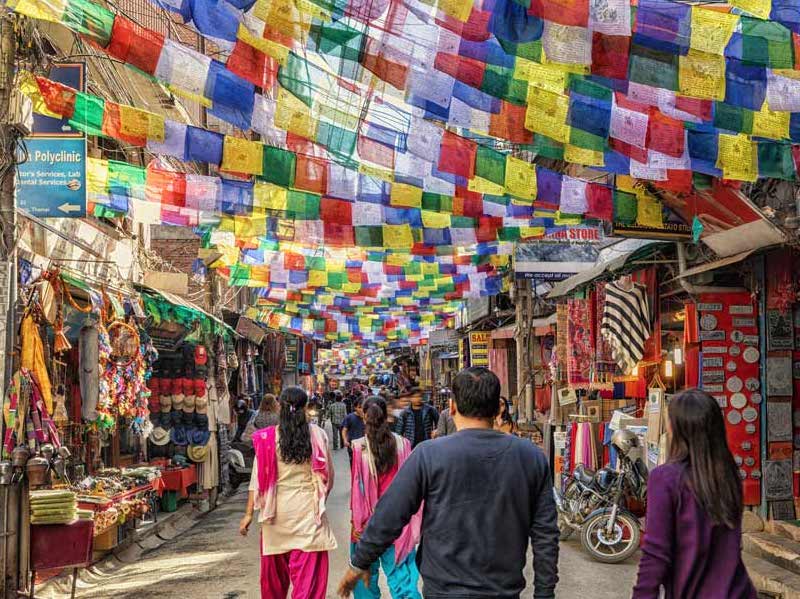
Sightseeing
Armed with a map, you can plan which sights you wish to visit, and when, to make it time efficient. If you are staying in Thamel, some will be walkable. All of the sites listed here were severely damaged during the Nepal 2015 earthquake. Some have been completely reconstructed with no evidence of the destruction. Some parts of other sites have not been completely rebuilt. Either way, it does not spoil any visit.
Boudhanath
More commonly known as ‘Bouddha’, this is not to be missed in my view. It is a UNESCO World Heritage Site. This huge Buddhist stupa is a beautiful and peaceful place. If you have time, plan to have lunch or coffee here. Sometimes the site is lit up after dark with thousands of candles, which is spectacular. Ask locally if this is happening whilst you are there.

Overall map of Kathmandu
Click the image to see a larger version

Boudhanath (Bouddha) – a must-see sight in Kathmandu.
Partially destroyed in the 2015 earthquake, it was repaired and reopened in Nov 2016.
Swayambhunath (Monkey Temple)
One of my ‘must-see’ sights. Any view from on high in Kathmandu and you will see Monkey Temple sticking out like a sore thumb. This ancient religious complex has developed over the years. The Buddhist stupa is its focal point (and also its highest). The nickname ’monkey temple’ derives from the group of monkeys that reside in the trees that surround the complex.
The main entrance is at the base of the steep stairway that leads directly up to the Stupa. It is better in my view to walk (anti-clockwise), enter the complex using the alternative entrance, and climb slowly to reach the stupa at the end. On the way, there are numerous temples, shrines, and shops. The exit will be down the stairway to where you began.
If you’re staying in Thamel, this is walkable (30 – 40 mins). Grab a map, get your bearings and keep asking for directions as you go. It’s a nice little morning’s adventure.
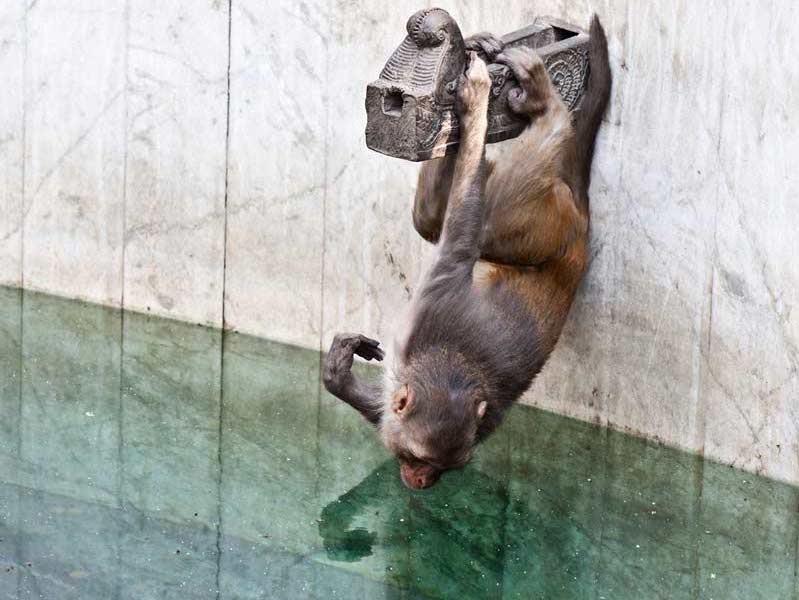
It’s not called Monkey Temple for nothing!
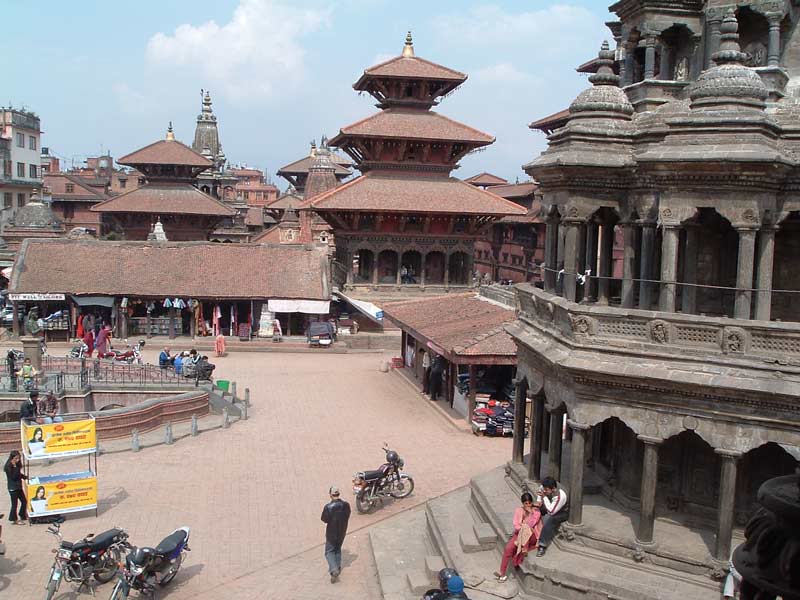
Patan’s architecture is based heavily on the Newar style.

Hand-made clay pots drying down one of Bhaktapur’s alleyways.
Pashupatinath
This sprawling Hindu temple site is the largest in Nepal. It is one of the four most religious sites in Asia. But it is perhaps more well known for performing open cremations on its numerous ghats. The Bagmati river flows through the site and is therefore considered holy by both the Hindus and Buddhists. There is the main entrance to the site, which leads down to the river, on the opposite side of the ghats. The cremations take place fairly frequently and you are free to witness them but please be respectful. You are after all witnessing a funeral. There will be no shortage of offers of assistance from locals in terms of information about what’s happening. They will expect a small fee for doing so. You are likely to pass this site a few minutes after you leave the airport en route to your hotel. It is also not far from Boudhanath, so a good idea to consider mixing these two together.
Durbar Square
Be careful when talking about Durbar Square(s), there are a few of them! The name (Durbar Square) is generally referring to the area opposite an old royal palace. They tend to consist of temples, idols, open courts, water fountains, and so on. There are 3 in the Kathmandu area: Kathmandu, Patan Durbar Square, and Bhaktapur Durbar Square. All are UNESCO World Heritage Sites. It is questionable if you need to visit all 3 Durbar Squares given their similarity. Kathmandu’s Durbar Square is walkable from Thamel.
Patan (Durbar Square)
As far as architecture goes (Newar style), this site is perhaps the most impressive. Even the floor, over a wide area, is tiled with red brick. Patan is considered a city (the oldest) within Kathmandu, but this is more historical than anything else. It has over 136 courtyards, and 55 temples in and around the main square, with numerous interesting nooks and crannies.
Bhaktapur
Bhaktapur is another ‘city’ in the Kathmandu Valley, and one of the most popular in terms of visitors. It’s like a little town. It is located about 8 miles from the center of Kathmandu and takes about 45 min to drive there. You will drive out past the airport. There is an entry fee, and once inside, you can wander the streets. It is classic Nepal. It is heavily built in the Newar style and has 4 ‘squares’ including a Durbar Square. There are plenty of places to eat, some cafes and if you wish to see the place when it’s quiet, you can stay the night. It is a nice place to see once the tourists have left!
How To Get To Kathmandu Sites
Assuming you are accommodated in Thamel, the only transport you need is to visit your chosen sites. You can either pre-arrange a guide and vehicle (with a driver) for the day or go it alone.
Pre-arranged. My experience tells me that visiting a max of 3 sites (excluding Bhaktapur) will be enough for a day tour. Trips of this nature normally start between 8 – 9am (picked up from your hotel) and continue until you have finished, usually mid-afternoon. It can include lunch.
Go It Alone. Decide where you wish to go, and grab a local taxi off of the streets. There is no shortage of local taxis. These journeys can either be single journeys, or you can hire the driver for the day. The latter is often better (and cheaper). You then know you have a ride and if you’ve grabbed him in Thamel, he’ll likely speak enough English to understand what you want. He will wait for you, and if you’re not sure, don’t pay the full amount until you’re back at your hotel!
Remember, both Swayambhunath (Monkey Temple) and Durbar Square (Kathmandu) are both walkable from Thamel.
Fees. Each site will charge a fee for entry. They vary enormously from a few hundred ruppees to just over 1000 NPR.
Other Considerations
The options of what to do don’t stop there. If you have more time, Kathmandu is one of those places that opens up once you are there. You could for example arrange an Everest flight. This small aircraft will fly towards the mountain so that you can view it. It will NOT go around its summit. If it did, it would be in China’s airspace!
There are guided walks, hosted restaurant nights with entertainment, and so on. You could decide to spend a night in Bhaktapur, or other places that are nearby, some with excellent mountain views. Pokhara is just a 30 min flight away. Beyond just a few days in Kathmandu, you’re talking about a whole new tour.
Our Reviews
Pokhara – What To Do & See

Everest Base Camp Review

Kilimanjaro vs EBC | Treks Compared | Which is Harder

Is The Maldives Worth It?


