
Can I Trek To Everest Base Camp in Trainers?
The question is not ‘if’, because you can, it’s more if you’re willing to take the risk. And it’s a big risk.
Allow me to tell you a short story … Many years ago I was walking directly behind a young lady along the Everest Base Camp trail; it was Day 2 of the trek. It was early in the day and we had just left Monjo, a village just 3 – 4 hrs from Namche Bazaar.
I couldn’t help but notice that she was wearing bright fluorescent purple trainers! There was no missing this lady on the move as she approached a small stream crossing the path. With boots on, you would not have broken stride. She stepped on the first of two stepping stones , and then the second … it gave way with enough movement for her ankle to go, and it was instant. The simultaneous cry of pain as she fell sideways to the floor told me everything I needed to know. I watched her ankle visibly swelled to twice its size in just a few seconds. I could see it expanding right in front of me as if it was going to burst.
Within that millisecond, her dream trip of a lifetime trek to Everest Base Camp was over. Finished.
A simple accident that can happen to anyone. But it could have been avoided.
Trek in Trainers – The Risks
- The terrain is uneven, rocky, sometimes wet, and slippy, and can be covered in snow and ice at times.
- Trainers are simply not designed for the terrain that the Everest region throws at you. Most trainers are not waterproof, the sole is inadequate and the ankle support is non-existent.
- What about Trail shoes? They are a step up from trainers; more robust, usually waterproof, and have a much better sole. But crucially, they have no ankle support.
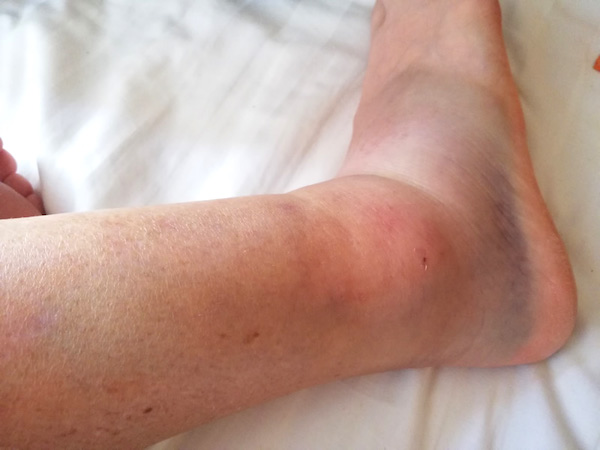
Is the risk of this happening worth it?
Why You Should Wear Boots
- Boots are designed to better protect your feet.
- The soles are designed to grip.
- They will usually be waterproof (make sure they are).
- The over-the-ankle design will protect your ankle from going over so easily.
- Boots may be heavier and less flexible than trainers or trail shoes but they will soon wear in and feel like a pair of slippers.

Trainers – simply not designed for Everest
Don’t Allow Confidence To Mask Risk
There are plenty of confident, sure-footed people out there with strong ankles and nimble feet who wouldn’t give wearing trainers or trail shoes a second thought. Let’s face it, you often see the odd porter in flip flops! Boots can be considered heavy and cumbersome at times, so trainers or trail shoes can be an attractive option.
There’s nothing wrong with using alternative footwear at the right times, if only to rest the feet if there’s an issue with the boots at times.
But don’t let self-confidence mask the need to mitigate the genuine risk of simple unforeseen accidents in terrain like the the Everest region, or any other similar terrain for that matter, including Kilimanjaro. If you want to take the risk, no-one can stop you. But accept the gamble that you’re taking.
Finally
I stopped to help that lady, who was in some pain and obviously distraught. The reality of the consequences of what had just happened hadn’t quite sinked in yet. After some rest, she decided to try and battle on hoping it would recover. To her credit, she hobbled up the ‘Namche hill’ using makeshift crutches. Alas, 2 days later she sensibly called it a day and was helivac’d back to Kathmandu.
I never had the heart to ask why she was wearing trainers.
Related Articles
Pokhara – What To Do & See

Everest Base Camp Review

Kilimanjaro vs EBC | Treks Compared | Which is Harder

Is The Maldives Worth It?


