

Climb Kang Yatse II
Ladakh’s Ultimate 6000m Peak
Ladakh’s Ultimate 6000m Peak
Kang Yatse II and the Markha Valley – an outstanding combination
| Group Dates | Land Only |
|---|---|
| 21 Jun - 4 Jul 2027 | from £1749 |
| 12 - 25 Jul 2027 | from £1749 |
| 16 - 29 Aug 2027 | from £1749 |
Advertised price is based on a min of 4 pax. For groups of 2 or 3 pax, add £100 per person, twin share.
Getting there
From the UK, the standard route is to fly to Delhi, and then a domestic flight to Leh. Be aware that due to weather conditions, most flights into Leh are early morning.
High Altitude Entry Destination. Leh’s airport is one of the highest commercial airports in the world (3500m). We allow 2 nights on arrival to assist with acclimatisation.

When to climb Kang Yatse 2?
Late Jun, July, and August are the best months to climb Kang Yatse 2.
Outside of these months, snow may prevent passage over the high passes.
Even though it is high season summer months, you won’t get School groups here!
Why choose our flexible Kang Yatse 2 expedition?
In traditional Travel and Trek style, we build our Kang Yatse II departures entirely around your safety, your schedule and your wishes:
- Your Dates, Your Choice: Pick any start date you wish within the prime Ladakh climbing season (late Jun – early Sep).
- Small-Group Experience: We run private departures for groups as small as 2 people. If you prefer to go at your own pace, and only yours, then keep your departure to yourself.
- Flexible Itinerary: We can advise on where delays may happen or where more time may be needed. You can choose and add as necessary.
- The Perfect Stok Kangri Alternative: With Stok Kangri closed, Kang Yatse II stands as the absolute best 6,000er experience in Hemis National Park.
- Avoid the potential busier 6000m Island Peak in Nepal.
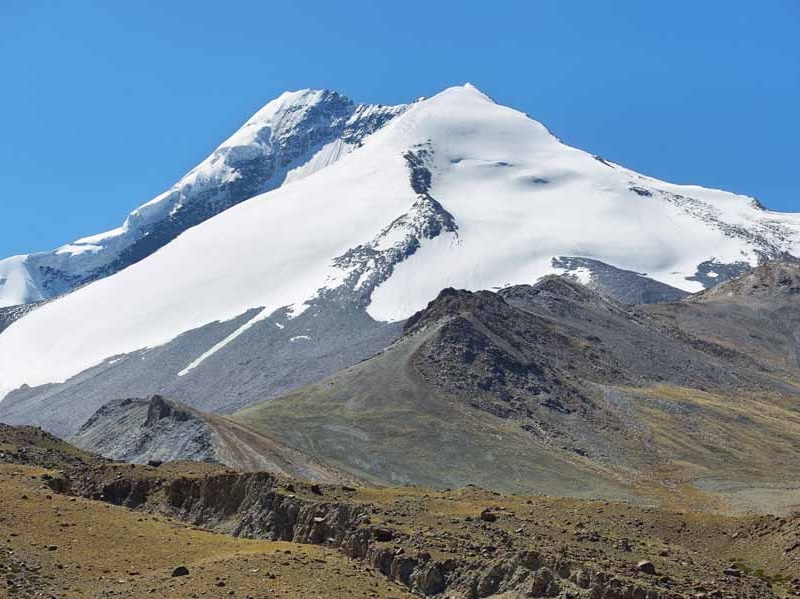
The slopes of Kang Yatse 2 (closer summit).
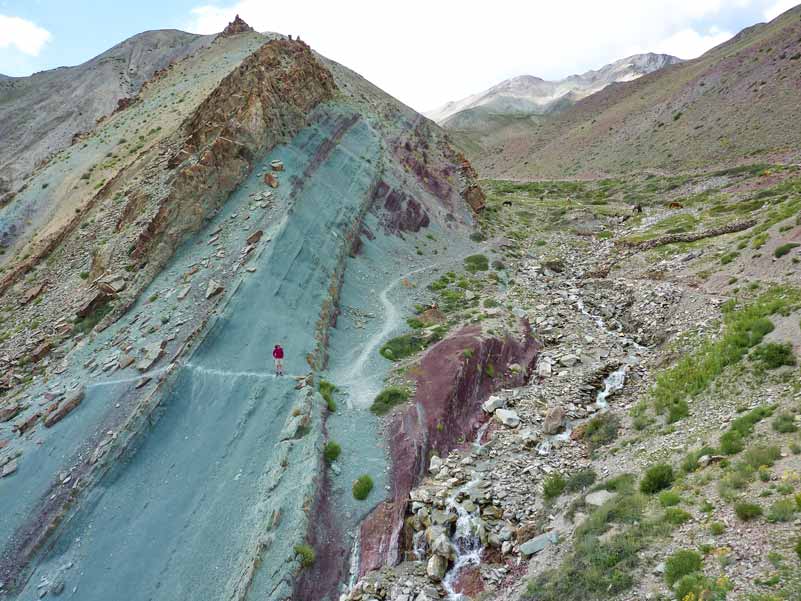
The stunning geology in the Markha Valley.
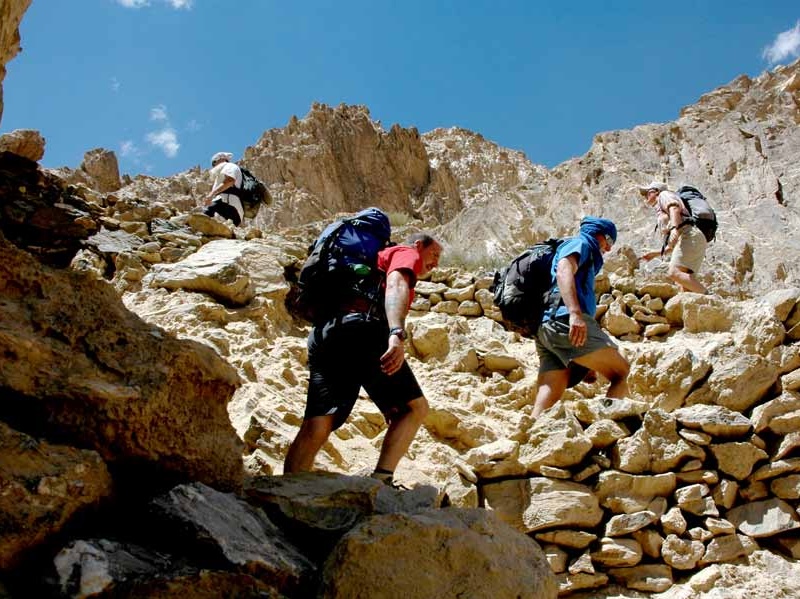
Classic trekking terrain.
India Notes
Essential Notes – essential reading on clothing and equipment such as waterproofs, boots, daysack, sleeping bags, travel insurance, travel health, and high altitude (opens new tab).
General Notes – covers generic information on our adventures (opens new tab).
Ladakh and Himachal Pradesh offer some of the best trekking in the world, with remote, low, and high altitude treks. The landscapes are beautiful. Combine anything in India with a short excursion to the unmissable Taj Mahal and possibly Jaipur too, all very close to Delhi.

You will require a visa to enter India. How to apply for a tourist visa for India. The evisa is the simplest and quickest method.
For the most up-to-date passport validity and visa requirements, please visit the FCDO Travel Advice India webpage.
International Flights. We do not include or sell international flights. We can assist you with advice on the best flights based on our extensive experience of such matters in order to get you to, and from your destination based on your own travel plans.
London not convenient? – Other regional airport options are possible. We appreciate the potential inconvenience of London if you live some distance away. Whilst using regional airports may cost more, and in this case may involve one stop, that cost may be offset by the cost and time of travelling to London.
Domestic/Internal India Flights. India is a vast country and some itineraries either require or offer domestic flights. Specific itineraries will tell you whether these internal flights are included or not.
Ladakh. The Delhi – Leh flight takes about 90 mins and usually departs early in the morning due to the prevailing winds in Ladakh (they get stronger during the day). These flights can be a bottleneck during the summer months so you are advised to book these as early as you can.
If trekking in India, you will need a daysack and a trek holdall. See our article on holdalls and luggage.
Daysack – Recommended capacity is 35 litres. The daysack stays with you all of the time when trekking and is likely to contain:
- waterproofs, fleece, duvet jacket, hat/gloves
- water, snacks
- sunhat, sunscreen, sunglasses
- personal hygiene (toilet tissue, hand sanitiser)
- camera
- personal first aid kit
Trek Holdall – A holdall is a soft-skinned bag that will carry the remainder of your clothing/equipment, wash kit and sleeping bag. The Porters/pack animals do not walk alongside you during the day therefore when planning your packing, bear in mind that once your bag leaves you in the morning, you may not see it again until you reach camp at the end of the day.
Travelling there – Depending on where you are travelling to (and therefore what’s going with you), and how you’re getting there (direct flight or transiting another airport), consider what luggage you use to get your belongings there. The airport baggage handling systems can be rough at times.
Storing Luggage in India – free and safe storage facilities are available in hotels so you can leave clothing behind whilst you trek.
If you are touring in India, and do not require a trek holdall, then take whatever luggage type suits you.
In general terms, unless stated otherwise, you will be met on arrival in India and transferred back to the departure airport at the end of the trip.
This will also apply when domestic flights form part of your itinerary.
The hotels we use in major cities such as Delhi will be of 4/5* standard depending on the location (city, town). The lower standard will only be used where we need to or there is no alternative. The average will be 4*.
Ladakh
In Leh, hotel/Guest houses are used and they will be of a good standard. The star ratings don’t really apply here as we would know them!
On trek, through the Markha Valley, we may use a combination of homestays and tents to provide a mixture of culture and comfort.
Single room option costs and conditions are stated on each trip webpage; they will vary. Please check if you are unsure. For example, it may be included for hotels but not on treks due to tent limitations.
Please refer to the itinerary for what meals are included.
Trekking, Ladakh – all meals are provided by the Camp Chef, whether you’re camping or using a homestay. This will include packed lunches. There are some small ‘parachute cafes’ along the route to buy snacks, but don’t rely on them.
Meals on all treks:
- Breakfast – a simple meal consisting of eggs and toast or cereal or pancakes and a hot drink.
- Lunches – packed, usually made at breakfast.
- Snack – usually supplied on arrival at the night camp; tea/coffee and biscuits or similar.
- Evening meal – 3 courses. Soup, main meal, and dessert.
Trekking, Himachal Pradesh – On the trek, a skilled camp chef will supply your meals. Don’t expect a lot of meat dishes to be available due to the problem of storage. Depending on the specific trek, any form of shops to buy additional snacks (such as energy bars) may not be available so you should be prepared to take your own.
Touring, or trips that include a significant No of hotel nights – as a minimum, breakfasts will be included and possibly evening meals too. Please check specific itineraries.
Water
You should only drink water that has been treated, ie bottled mineral water or water that has been treated (ie boiled).
On the trek, the water will be prepared for you (boiled).
When touring, you can buy as you go (it is inexpensive).
India’s currency is the Indian Rupee (INR). You will not be able to obtain INR’s prior to arrival. We recommend that you work in INR’s in India. It is cheaper and the preferred currency, especially in the hills.
If you are trekking, we suggest that you take the majority of your money in cash as you will exchange the majority of it soon after you arrive in the country. Most treks depart the day after you arrive in-country (not in Ladakh) and once you leave for the trek, there are few if any opportunities to exchange.
ATM’s – If you prefer not to carry all of your money in cash en route to your destination, it is possible to withdraw money from ATM’s in cities, towns, and the airports. If you have more than one credit/debit card you can use, take it. It will provide flexibility should one not work for any reason.
Traveller’s cheques. While still valid, they are increasingly disappearing as a means of carrying funds. With the exception of major banks, you may find it very difficult to use them. The simple advice is to avoid them.
Exchange Shops – There is no shortage of money exchange shops on the city streets of India.
Spending money – This will depend hugely on what trip you are on and on your spending habits. Approximately £300 – £400 should be allowed for miscellaneous expenses including meals not included in the itinerary. It is sometimes better to go with more and to bring it back than to find yourself short (if you work in cash).
Credit cards – We recommend that you carry a credit card with you at all times for emergency purposes (preferably a travel credit card.). They are acceptable in larger shops, restaurants, and hotels but maybe not in smaller shops in smaller villages.
Tipping – In India tipping is a way of saying ‘thank you’ for your services. Our advice is to budget approx £30 – £45 per trekker (local currency equivalent), placed into a ‘pot’ and split between the Guide and other support staff. It is better to nominate one person to give tips to individuals rather than to give it to the Guide to distribute; it is more personal that way.
Fitness is very subjective and India has a huge range of challenges.
It is not practical to offer specific training advice here due to the vast array of challenges and fitness levels of those reading this. Our simple rule of thumb for treks in India is that if you are able to trek for 5-6 hrs per day*, on two consecutive days, over undulating terrain carrying your daysack (fully loaded, around 6-7kg) then you should be perfectly capable of completing the vast majority of our treks in good order.
Apart from the physical element, trekking to high altitude will have an effect (often more than the physicality). Can you train for altitude?
You don’t need to be super fit but we recommend that you adopt a regular training regime in the lead-up to your trip as the fitter you are, the less fatigued you may be and therefore the more you will enjoy it. Treks here are all about slow burn endurance; nothing speedy! Train for what you are going to do – walk, and with a daysack on your back that weighs 6-7 kg. Gear it towards ascending.
It is equally important to train your body to walk with the clothing and equipment that you will be using on the trek.
For specific advice call Terry: 07725 943108
All of our treks in Ladakh, and most in Himachal Pradesh will ascend to high altitudes. You are strongly advised to read about what Acute Mountain Sickness is (AMS, aka altitude sickness), be aware of the effects, the symptoms, and what to do if you succumb. Please read our section on High Altitude in the Essential Notes section (opens another page).
If you would rather speak to us for advice, call Terry: 07725 943108
India is a warm/hot country and in general terms, that is what you will experience.
Tours and cycle trips can expect a warm/hot environment with air conditioning required in overnight hotels.
If you’re trekking, you can expect a moderately warm environment whilst the sun is up (approx 20 deg C) but as soon as it goes down, the temperature will drop quickly (down to single figures overnight and well below freezing at the higher altitudes). Shorts/trousers and a t-shirt will be the standard style of dress on a daily basis until you reach higher altitudes when something warmer will be needed. In the evenings you will require several layers of clothing.
As soon as you add higher altitudes (above 4000m), expect the temperatures to drop to below zero overnight.
If it rains, it will tend to pour down hard for a short period of time and then dry.
Weather forecast in Leh, Ladakh.
There is no guarantee of any specific weather pattern. Please take the appropriate clothing and equipment.
Advice for vaccines is constantly developing. Visit your GP and the following UK travel advice website for the most up-to-date advice (including malaria) and information on where you will be travelling to. Don’t forget to include ALL travel if it includes a wider itinerary.
Also see our ‘Travel Health’ section with the Essential Notes section (opens another page).
Depending on your trip, you are highly likely to be met at the airport.
Your Guide (english speaking) is likely to meet you at the hotel shortly after you arrive, providing any briefing you need and timings for the coming days. The more you engage with him, the more you’ll get out of him! The Guide will know where to get further support if required.
Other support on trek will consist of a Camp Chef and either porters or pack animal handlers, or both.
If you are cycling, you’ll also have a back up crew of a mechanic and driver.
For touring, it’s likely to be the Guide (who may be with you throughout your time in India) and a driver (you have numerous if your travel includes domestic flights and train travel).
Mobile Phones
Mobile phone coverage is generally good in India. Coverage on trek is varied due to the remoteness but the locals are equally reliant on mobile phone use and therefore will know where to get signals!
Local sims are cheap and easily obtainable.
Be very careful using mobile phones at high altitudes when the temperatures are very low overnight; they can freeze and destroy the phone!
Most hotels have free wifi.
With a combination of some internet cafes in most cities and towns and the availability of wifi in cafes, fast food outlets, etc… the facilities are there to access email and other forms of data communication from mobile phones at no cost.
India has a 220v, 50 Hz supply. Normal 2-pin European continental adaptors will work. World Power Plug and Adaptors – check what works.
Extensions In India – infinite options

Agra – Taj Mahal and Red Fort
Experience the great Indian railways and connect down to Agra (driving is an alternative). Once in Agra, you can visit the Red Fort on the same day and the truly majestic Taj Mahal at sunrise (the following day).
After the Taj Mahal, you have time to travel back to Dehli to get your flight back to the UK, so this is just a 1-day extension.

Delhi – 2 Nights
Cap off your trip with 2 additional nights (or 3 nights) in this bustling, and yet cosmopolitan city. Compare Old Delhi (Chandni Chowk) with the new modern Delhi. It’s a stark comparison and best done (in our view) from the seat of a tuk-tuk! Hire a driver who will only be too happy to whiz you around the city to show you the sites. It’s the quickest, most fun, and cheapest.
- Combine 2 nights here with 1 night to see the Taj Mahal
- Experience Chandri Chowk, India Gate, Red Fort, the markets
All of our holidays can be tailor-made for YOU and we make it simple. It’s so easy to do.
Popular Treks and Cycles

Kilimanjaro, Lemosho

Annapurna Circuit

Ngorongoro Bike Ride, Tanzania

Sahara
Our Reviews
Pokhara – What To Do & See

Everest Base Camp Review

Kilimanjaro vs EBC | Treks Compared | Which is Harder

Is The Maldives Worth It?


