
Any departure date – guaranteed – min 2 Pax – £1395 pp, excluding flights
Visa Free – up to 30 days

China Great Wall Trek
Trek this ancient architectural marvel that stretches for thousands of miles
Visa FREE – for up to 30 days.
See our Notes below for the full requirement.
| Group Dates | Land Only |
|---|---|
| 30 Aug - 6 Sep 2026 | £1395 |
| 13 - 20 Sep 2026 | £1395 |
| 11 - 18 Oct 2026 | £1395 |
| 11 - 18 Apr 2027 | £1395 |
| 9 - 16 May 2027 | £1395 |
| 30 May - 6 Jun 2027 | £1395 |
Prices based on a min of 2 people (sharing), 3-star hotel in Beijing (2 nights) and arriving at Beijing’s Peking (code PEK) airport.
Upgrade to 4* hotel in Beijing (2 nights) – £100 pp.
Getting there
There is plenty of choice with airline choice, direct or indirect, but be aware of which airport you choose to fly into.
The original Beijing airport (code PEK) is much closer than the newer Daxing (DAX) airport. We collect you from both but there is a supplementary payment for collections from DAX.

Extend in China?
But it doesn’t have to stop there. Why not use of your time in China. Experience the 300 km Bullet Train to Shanghai, head up to Xi’an to see the Terracotta Army, or travel to Chengdu to see the Pandas.
You may opt to spend more time in Beijing too. China extensions.
There are unlimited options, talk to us to craft your own itinerary.Ask a question, or call Terry: 07725 943108

The original parts of the Great Wall are amazing.
Steps can be steep, and relentless!
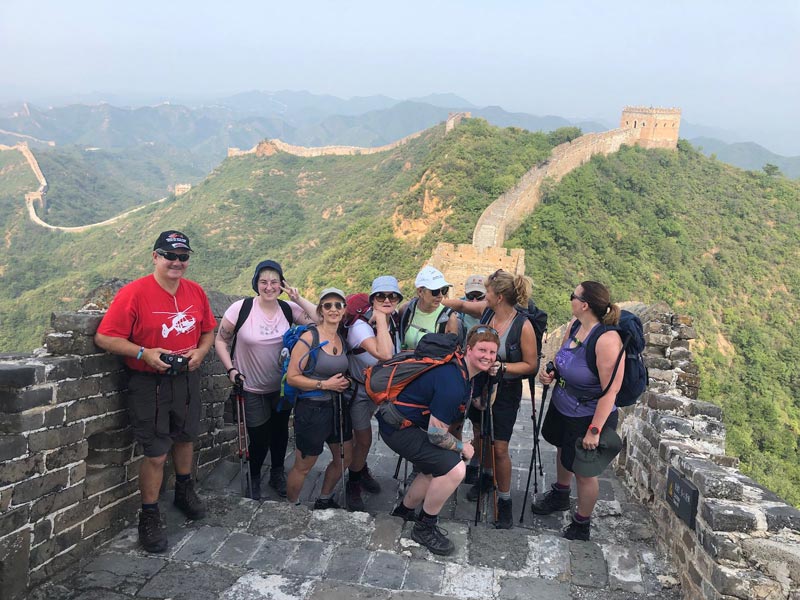
China’s vast Great Wall stretches for mile upon mile.
China Notes
Essential Notes – essential reading on clothing and equipment such as waterproofs, boots, daysack, travel insurance, and travel health (opens new tab).
General Notes – covers generic information on our adventures (opens new tab).
The Great Wall of China is a world icon that deserves to be experienced. One of the few structures on earth that can be seen from space, it stretches for endless miles, a snaking undulating path of history and a feat of ancient engineering.
Our trek on the Wall cherry-picks some excellent sections, both restored and unrestored. We also camp for 1 night alongside it, providing a very different aspect. The options to extend your time in China are excellent from simply more time in Beijing to take the super fast Bullet train to Shanghai for a few nights stopover.
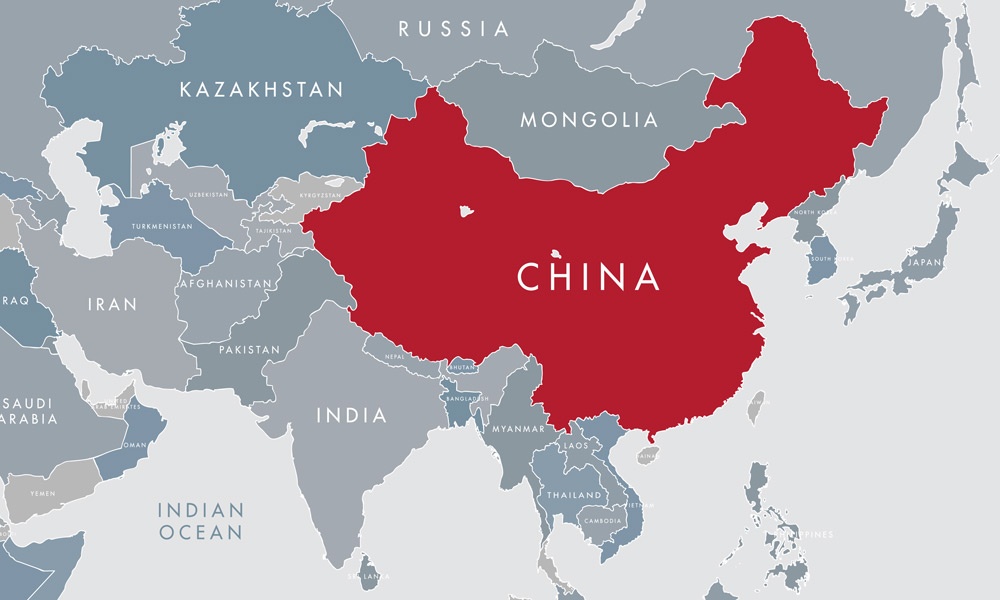
Passport & Visa – For tourism visits of up to 30 days, you will need a valid passport (valid for at least 6 months from the date you arrive in China), 2 blank pages and proof of a return air ticket to enter China.
You are likely to have to complete an Arrival card (digital or paper), and the authorities are likely to collect biometric data (fingerprints/photograph).
For up to date requirements (they can change), read the UK FCDO’s webpage on entry requirements for China.
International Flights – We do not include, or sell international flights. We can assist you with advice on the best flights based on our extensive experience of such matters.
Be aware that there are two major international airports in Beijing. Beijing Capital International Airport (code PEK) is the original airport. The newest is Beijing Daxing International Airport (code PKX). Our standard pick up is from PEK. If you arrive through PKX, there is a supplementary charge of £40 per vehicle, split between however many clients are in the vehicle.
Internal Flights – if internal flights in China form part of your itinerary, be aware that the hold baggage allowance may be smaller than that of the international flights.
If trekking in China, you will need a daysack and a ‘main bag’.
Daysack – Your daysack is what you will carry on the trek and is therefore going to be with you for most of the time throughout the trip. The recommended capacity is 25 – 35 litres. On the trek it is likely to contain the following (weight fully loaded 6 – 7 kg):
- waterproofs, fleece, duvet jacket, hat/gloves (weather dependent)
- water, snacks
- sunhat, sunscreen, sunglasses
- personal hygiene (toilet tissue, hand sanitiser)
- camera
- personal first aid kit
Main Bag – Your main bag can be any type of luggage from a suitcase to a holdall. It will carry the remainder of your clothing/equipment that’s not in the daysack. It will be transported from night stop to night stop by vehicle.
Travelling there – Depending on where you are travelling to (and therefore what’s going with you), and how you’re getting there (direct flight or transiting another airport), consider what luggage you use to get your belongings there. The airport baggage handling systems can be rough at times.
Return airport transfers are included on standard itineraries in China (from PEK).
Be aware that there are two major international airports in Beijing. Beijing Capital International Airport (code PEK) is the original airport. The newest is Beijing Daxing International Airport (code PKX). Our standard pick up is from PEK. If you arrive through PKX, there is a supplementary charge of £40 per vehicle, split between however many clients are in the vehicle.
Additional payments will be required if transfers are requested/required outside of a group itinerary, for example if you have chosen to extend and the transfer is on another day to those travelling back on the standard itinerary. If you are on your own bespoke itinerary (no other travellers in the group), this will clearly not apply.
Beijing Hotels – we use a variety of good quality hotels (3/4 *) depending on the itinerary.
Xi’an Hotel(s) – 4* hotel.
Great Wall Accommodation – Local farmer guesthouses or similar relative basic establishments. They have twin bedded rooms, western style toilets and showers. Bed warning! – the mattresses can be quite hard as they are made of straw.
Single room option cost is stated in the price box at the top of the page.
Food
All of your meals will be supplied by either the accommodation we are using and/or supplies carried with us. We appreciate the creature comforts western clients like and have adapted accordingly.
Options for breakfast are homemade pancakes, omelettes, cereals, other local food, tea, coffee, water.
Picnic Lunches (if used) are usually a spread of breads, ham, cheese, salad (cucumber, tomato, etc..) and you can make your own.
Lunches in guesthouses are a mix of Chinese food.
Evening meal; meat and vegetables + drinks.
If you have a preferred snack bar or similar, consider taking your own as China is pretty much stuck on Snickers!
Catering for vegetarians presents no issues.
Most dietary requirements can be catered for if we are aware in advance.
Water
On the trek, we supply unlimited safe drinking water (no cost).
Depending on the size of the group, a ‘water station’ may be set up just before you get going on the Wall for the day. You just fill up what you need for that day’s trek and off you go.
Use bottled mineral water in hotels and when out and about. Do not drink tap water.
The local currency is the Chinese Yuan (CNY). You will not be able to obtain local currency before you arrive in the country. We recommend that you change your cash (UK Sterling) into CNY as local purchases work out cheaper.
On arrival in China, on standard Great Wall itineraries you are transferred out into the mountains (no overnight stay in Beijing). Depending on your day and time of arrival, you may need to exchange your money inside the airport. Whilst we often drop by the local banks for this purpose, flights arriving very early morning or on a Sunday for example, this option will not be available. Please be aware of the timings and day of arrival when considering this.
You will require CNY for any purchases throughout the duration of the trek + staff tipping (see below) at the end of the trek prior to your time in Beijing.
Once you leave Beijing for the mountains, there are no places to exchange money.
Credit Cards are widely accepted in cities. There are plenty of ATM’s in Beijing. Travel credit cards.
Traveller’s cheques are accepted in major banks but considered impractical for this trip.
Spending money – This depends on your spending habits and overall itinerary. Approximately £300 – £400 should be allowed for miscellaneous expenses and it would mainly be in Beijing.
Tipping – Tipping in China is just that; a way of saying ‘thank you’ for your services. It does not form part of their wages. Our advice is to budget approx £60 – £70 per trekker (local currency equivalent), placed into a ‘pot’, and split between the Guide and driver. It is better to nominate one trekker to give tips to the individuals. Once we know the final group size we will be able to be more specific about the tipping level.
Fitness is very subjective and in general terms, you should always train for what you will encounter. In this case lots of steps, both up and down.
You will be walking between 3 – 5 hours per day, occasionally longer if it is necessary. Distance is irrelevant as the terrain plays a huge part, therefore we always work in hours.
There are lots of steps on this trek! The Great Wall follows the naturally undulating terrain so it’s generally either up or down; rarely flat for very long. It can be quite demanding in places but taken at a sensible pace, it can be achieved. Clearly, your knees and legs in general will take the brunt of this physical activity. We recommend a reasonable level of fitness and adopt a regular training regime well before you depart.
There are no altitude issues, the highest point on the entire Wall is only 1534m so way inside anything that will affect you.
It is equally important to train your body to walk with what you will be using on the trek; clothing, footwear, and the daysack. The daysack is of paramount importance. 6-7 kg will weigh heavily on your shoulders if you have an ill-fitting daysack or one that has no waist belt to speak of.
How to choose a daysack.
If you are able to trek for 5 hrs per day, on consecutive days, carrying your daysack then you should be perfectly capable of completing this trek in good order.
Temperatures during the day (sun up) will vary between 15°C – 35°C and the night temperatures correspondingly lower.
For any advice on fitness – call 01529 488159 or 07725 943108.
In general terms, for the months we travel to China, you can expect warm temperatures during the day (20 – 30°C). Once you are on the Wall, you are generally committed to walking until the end of that section. The Watchtowers along the Wall afford temporary shelter should you experience bad weather. You should carry suitable clothing and equipment at all times.
Visit your GP and the Travel Health Pro website for the most up-to-date advice and information on where you will be travelling to. Don’t forget to include ALL travel if it includes a wider itinerary.
Your local guide will meet you on arrival at the airport. He will be with you throughout your trek and he speaks good english. Depending on the size of the group, there may be a secondary guide. You will also have a driver (vehicle size depends on the group size).
Mobile Phones
Mobile phone coverage is very good in China; very few flat spots no matter where you are.
Hotels and some Guesthouses have wifi but please note that some popular social media websites are blocked in China. If you wish to have unrestricted access to the internet, consider using a Virtual Private Network (VPN).
Most UK mobile providers offer bundles for mobile use abroad. Please check with your own provider.
China’s electricity supply is 220v, 50Hz. A variety of plugs can be used although the most common for UK Nationals will be the European continental 2-pin sockets.
China Extensions
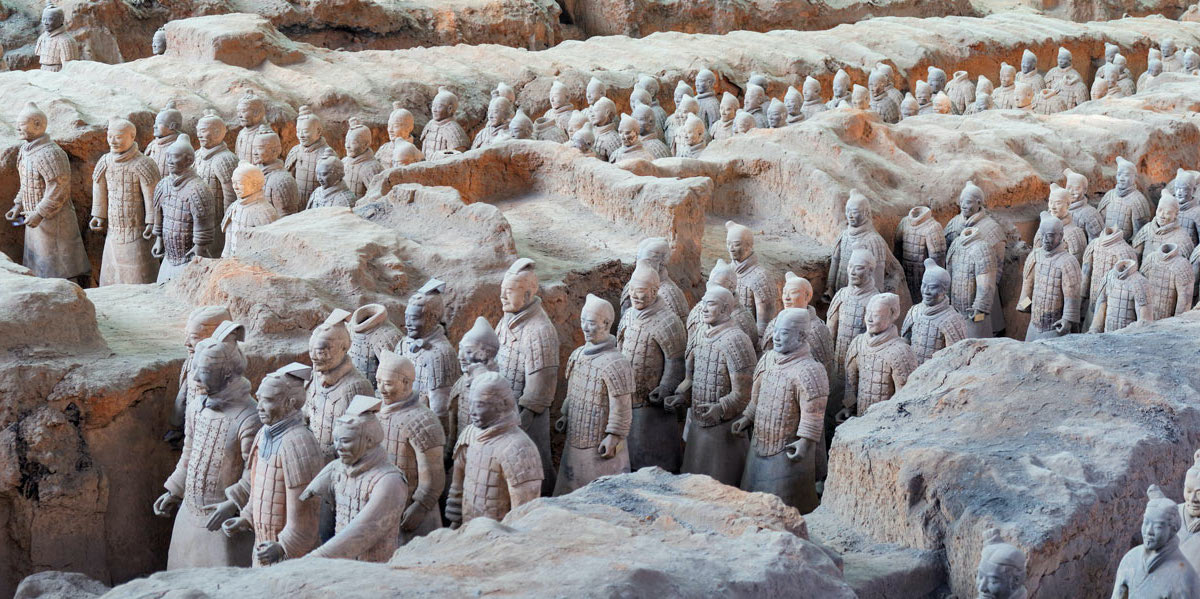
XI’an – TERRACOTTA ARMY
Take the bullet train to Xi’an for 1 night to see the incredible Terracotta Army.
- Day 1 – train to XI’an, visit the Terracotta Army.
- Cycle on the city walls.
- Overnight hotel.
- Day 2 – Visit the Muslim Quarter.
- Train to Beijing.
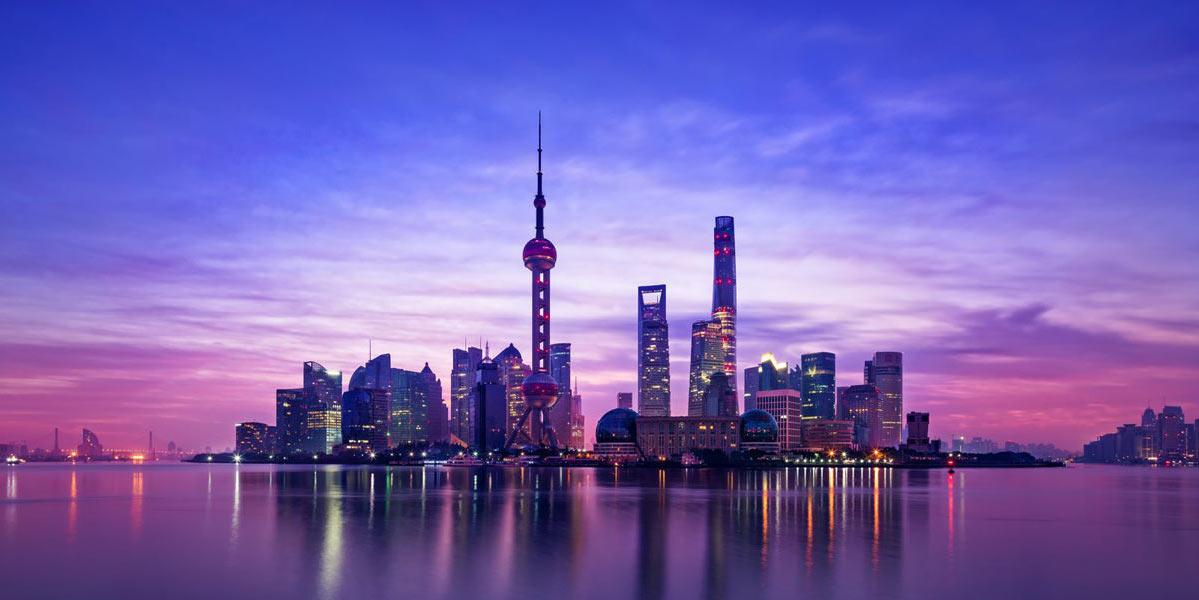
SHANGHAI
Take the bullet train to Shanghai to finish off your adventure. In complete contrast to Beijing that showcases China’s imperial past through its palaces, temples and historic landmarks, Shanghai represents the country’s modern face. Set on the banks of the Huangpu River, the city is famous for its futuristic skyline, vibrant atmosphere and blend of Eastern and Western influences. Dynamic, cosmopolitan and constantly evolving, Shanghai offers an exciting insight into contemporary China while retaining glimpses of its rich heritage.
All of our holidays can be tailor-made for YOU and we make it simple. It’s so easy to do.
Popular Treks and Cycles

Kilimanjaro, Lemosho

Annapurna Circuit

Ngorongoro Bike Ride, Tanzania

Sahara
Our Reviews
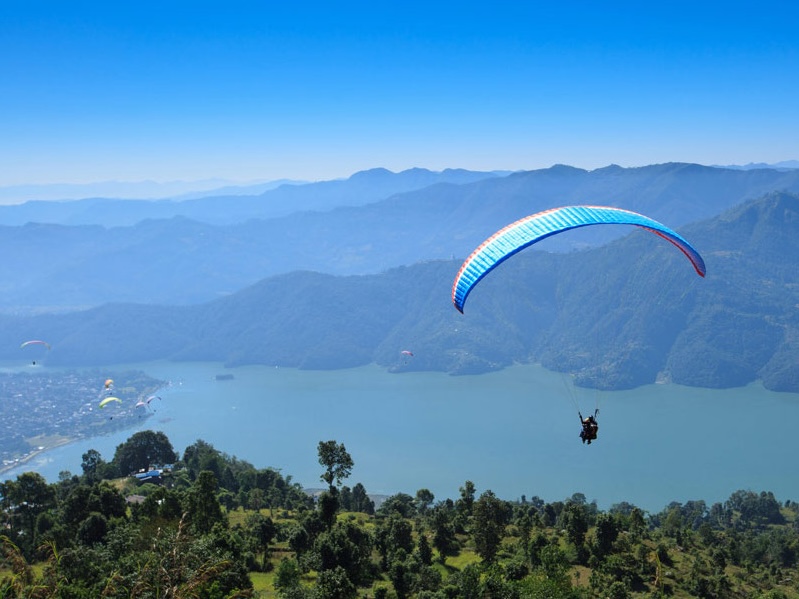
Pokhara – What To Do & See

Everest Base Camp Review

Kilimanjaro vs EBC | Treks Compared | Which is Harder

Is The Maldives Worth It?


