
Drinking Water In The Everest Region?
What Are The Options?
What Are The Options?
Working on an average of 3 liters per day, on an Everest Base Camp trek, you’re likely to drink around 40 liters of water. That’ll cost about £50 if you were to purchased mineral water as you go. You have to drink, there is no question about that.
Cost vs Convenience vs Environment
This article outlines the options for obtaining safe drinking water in the Everest region. Not one solution will suit everyone.
Buy As You Go (plastic bottles)
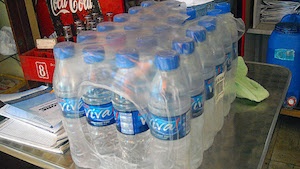
There is no shortage of 1 litre plastic bottles of drinking water in the Everest Region. It is by far the most popular method for the sheer convenience factor. But it does add enormously to the plastic rubbish mountain. The cost per 1 litre bottle in Kathmandu will be about 30 – 40p. In the hills they start at about 80p and work upwards as you get more remote. Cost much higher up can reach £2.50 – £3 per bottle.
Filtration Units
Filtration units such as the ones made by Katadyn are excellent at doing what they’re designed for. They filter just about anything and everything from bad taste to microorganisms to make the water safe to drink. They appear costly upfront but if shared, it will cut costs and you can either use it again and again or sell it and recover some money. The water is passed from the water source (such as a bowl filled with water from a tap) through the unit and into your drinking bottle. They are capable of filtering over 1000 liters without a filter change so they can cope with any trek in Nepal even for a small group of people. Other similar models are available.
Some bottles have integral filters inside them, so you just fill up your bottle, put the lid back on and drink. The Katadyn 1 liter container is a good example as is the Water To Go product (found on Amazon). 200 liters of water is their stated limit before a change of filter is required. Be wary that any filter put between your mouth and the water will invariably slow down the flow rate so you do need to suck hard! If you like to gulp down water, this won’t be for you!
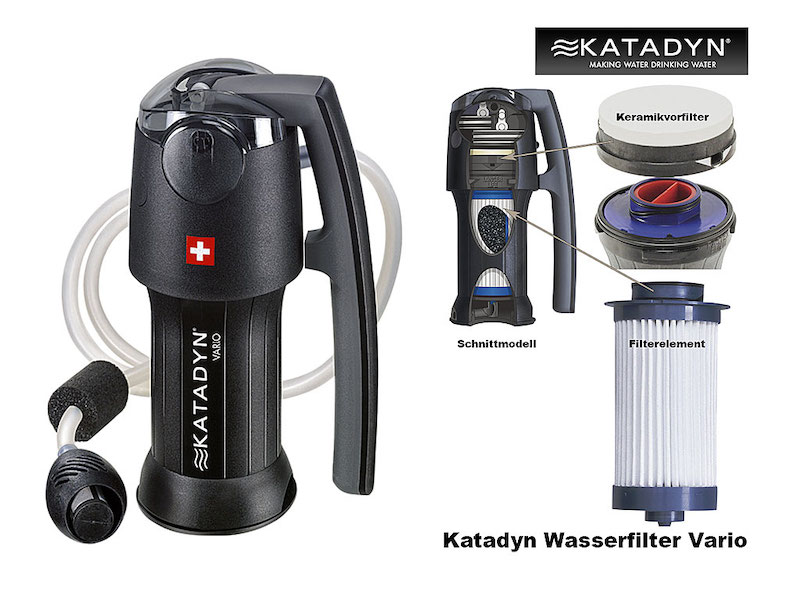
The classic Katadyn Vario Filter
Purification Tablets
There are numerous types of purification tablets on the market, all designed to make water safe to drink. Some give a bad taste and therefore a ‘neutralising’ tablet may also be required. Flavoured effervescent tablets are an option worth considering. Tablets are relatively cheap but well worth doing some homework on what tablet does what. My advice is to give this a trial on a training walk well before you go to see if you can stand the taste!
On a similar theme, there are also steripens, which ‘zaps’ the water using UV light, killing bacteria and viruses amongst others.

Katadyn’s Steripen, uses UV light
Boiled Water
The most effective way of purifying water is to boil it. At sea level that’s a ‘rolling’ boil (bubbling like mad) for 1 min, at 2000m altitude for 3 mins, and more the higher you go. Given the time that it takes to cool the water, this does need some planning of the timing to make sure that you have the water ready to go when you need it. You also need bottles capable of taking hot water (if not boiling; Sigg bottles are a classic example). It is cheaper to buy 1 liter of boiled water than a plastic bottle.
5. Fresh running water? You may be asking yourself the question why this is not in the equation? After all, you won’t fail to notice the gushing glacial rivers flowing down from the mountains! The villages pipe their water in from these rivers, using gravity. But all along the route, there will be people and animals living above where you are and are highly likely contaminating the water source. Do not trust it.
Fresh Glacial Running Water
You may be asking yourself the question why the gallons of glacial water gushing down the mountains is not in the equation? After all, you won’t fail to notice it. The villages pipe their water in from these rivers, using gravity. But all along the route, there will be people and animals living above where you are and are highly likely contaminating the water source. Do not trust it.
Summary
The sheer convenience of the plastic bottle method is what keeps it going; demand. But given the climate change issue (and when you see ther number of bottles used up there), there is an understandable continued shift towards the more eco friendly methods and rightly so. Only you can decide what method(s) you wish to use in the cost v. convenience v. environment debate.
Some of our Everest region treks: Everest Base Camp, Gokyo Lakes, Everest High Passes, Island Peak.
Our Reviews
Pokhara – What To Do & See

Everest Base Camp Review

Kilimanjaro vs EBC | Treks Compared | Which is Harder

Is The Maldives Worth It?


