
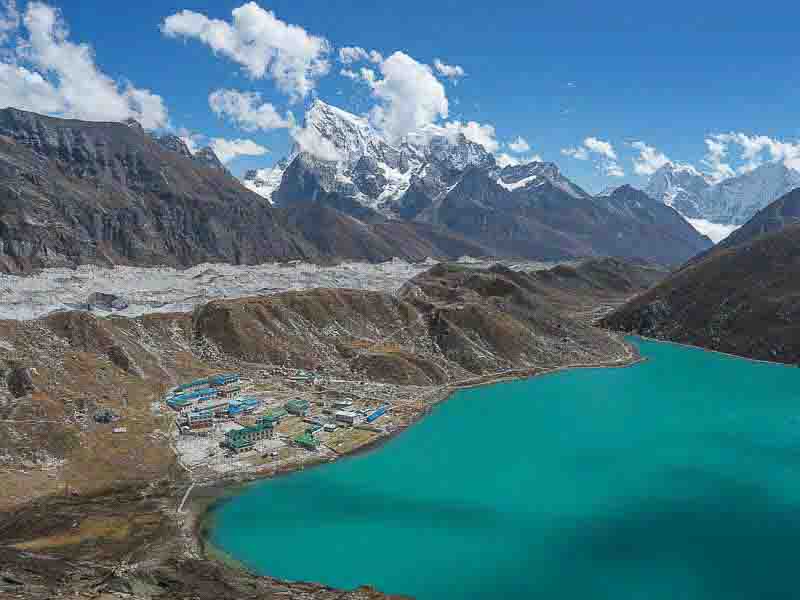
Gokyo Lakes Trek
Beautiful tranquil Gokyo Lakes | Few people trek here
Departures for 2 people | Choose your departure date
| Group Dates | Land Only |
|---|---|
| 20 Sep - 3 Oct 2026 | £1855 |
| 11 - 24 Oct 2026 | £1855 |
| 25 Oct - 7 Nov 2026 | £1855 |
| 21 Mar - 3 Apr 2027 | £1855 |
| 4 - 17 Apr 2027 | £1855 |
| 18 Apr - 1 May 2027 | £1855 |
Special Attention
Be aware of How Lukla works. We have factored in time to ensure you have sufficient time to get to the Gokyo Lakes in all but exceptional circumstances.
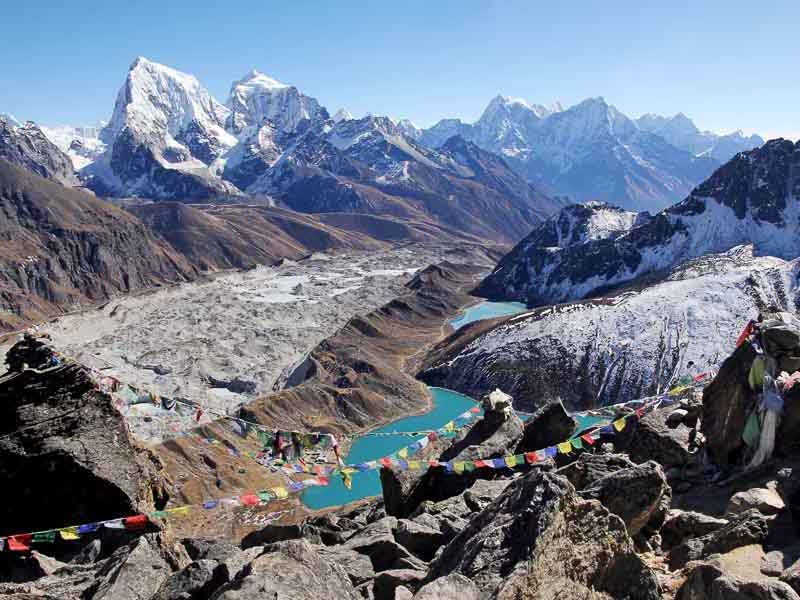
Classic Gokyo Lakes village
Gokyo Lakes
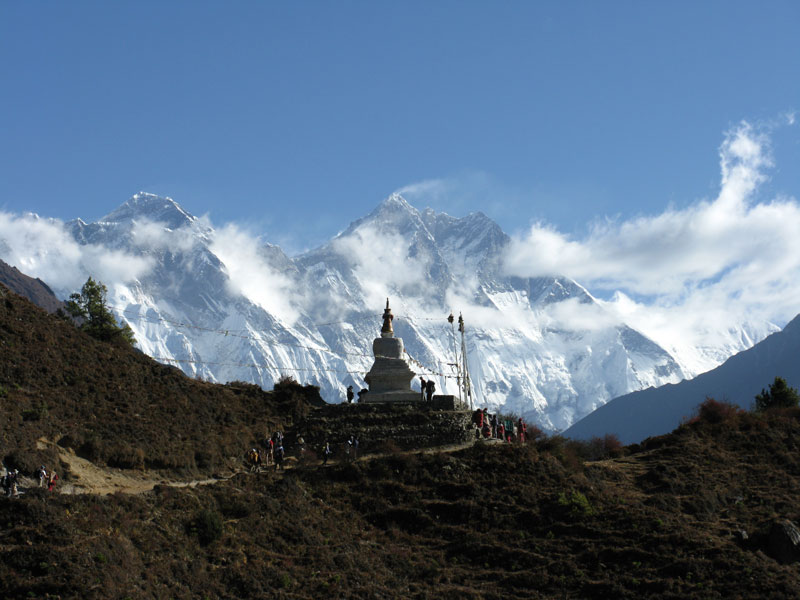
Big peaks on the trail out of Namche Bazaar
Nepal Notes
Essential Notes – essential reading on clothing and equipment such as waterproofs, boots, daysack, sleeping bags, travel insurance, travel health and trekking high altitude (opens new tab).
General Notes – covers generic information on our adventures (opens new tab).
Famed for the Himalayas and the Gurkhas, Nepal is a small land locked Nation and home to the awe-inspiring snow capped mountain scenery as well as the hot jungle clad Terai region bordering India. Primarily a Hindu country, there are strong links to the Tibetan Buddhist culture.

Download the kit list:
Passport – You are advised to have 6 months of validity on your passport when you apply for or obtain your visa.
Please check the UK’s FCDO website for Entry Requirements into Nepal. As circumstances can change, it is advisable to subscribe to the ’email alerts’ available from the FCDO’s webpage for Nepal. Click the link above and you will see the ’email alert’ subscription link just under the page title.
Visa – You will require a Tourist Visa to enter Nepal. You can obtain your visa prior to travel or on arrival at Kathmandu’s airport:
Prior to arrival (strongly recommended). You can do this by post, or in person in London. You must first complete the online application form.
Before you begin, have handy your passport details, an address in Nepal (we will provide), and an e-copy of both your passport photo page and a passport-style photo (1.5 inch square) ready to upload. You will also need a card payment method. Go the Nepal Embassy website for further advice. If you require any advice, please email us.
On arrival at Kathmandu’s airport. You can complete an application form online, which is a sort of pre-registration. That paperwork is then taken with you to Nepal and the remaining process is done at Kathmandu’s airport. This will take a lot longer when you arrive. To start this process, use this link and look for the ‘Visa On Arrival’ box (top line, 2nd box in from the left).
All visas now are multi-entry within the 15, 30, or 90-day visa issued.
We do not include or sell international flights. We can assist you with advice on the best flights based on our extensive experience of such matters in order to get you to, and from your destination based on your own travel plans. Read our article on flying to Kathmandu; flight routes, airlines, and airports.
London not convenient? – Other regional airport options are possible. We appreciate the potential inconvenience of London if you live some distance away. Whilst using regional airports may cost more, that cost may be offset by the cost and time of travelling to London. Please ask for advice.
Domestic Flights – The cost of domestic flights in Nepal is included if it forms part of your itinerary. The aircraft range from small 18 seater’s (generally up to the Everest area) to 30-60 seaters (to/from Pokhara). Luggage allowance to Lukla (Everest area) is no more than 15kg (see ‘Luggage’ section).
Safety – Be aware that the Civil Aviation Authority of Nepal does not operate to the same standards as those of western nations. The UK’s FCDO cannot offer advice on the safety of individual airlines, further information can be found on the FCDO’s travel advice webpage for Nepal.
Without such transport, accessing high and remote areas of the Himalayas would not be possible within reasonable time frames.
Whilst we accept that we have a duty of care to clients, there are obvious limits to what we can control given the nature of the terrain and domestic flight carriers. If your trip includes a domestic flight (it will state it in the inclusions/exclusions of each trip), you must accept that the flight is an acknowledged risk and we can accept no liability for personal safety in this regard.
Lukla Delays – Please note that poor weather conditions can cause delays on the flights to and from Lukla. Our itineraries have built-in flexibility to withstand cancelled flying days, and still maintain safe acclimatisation. The number of days that can be lost through cancelled flying days whilst still achieving the aim will depend on your chosen trip.
If flights are cancelled for the day, you will spend an extra night in Kathmandu at a hotel. This may or may not be at the same hotel you have stayed in, it will depend on availability. We will bear the cost of 1 additional night of hotel accommodation in Kathmandu on the outbound flight, and 1 additional night in Lukla for the return flight due to cancelled flying days. Any additional nights in either direction will be the responsibility of the client. They are not transferrable. You should keep all receipts, you should be able to make a claim on your travel insurance.
In the unlikely event that the number of cancelled days progresses to a point where the aim of the trek is no longer possible within safe acclimatisation limits, we will make alternative arrangements within the time frame. This can either be another trek in a different region, or a shorter trek in the same region.
Helicopters can sometimes fly when the scheduled fixed-wing aircraft cannot. If your group is offered the opportunity to use a chartered helicopter, either flying up to Lukla or back to Kathmandu, the cost will be shared between those choosing to take this option. In the extremely unlikely event that flight cancellations cause you to miss your homeward international flight, we will render all assistance, but cannot be held liable for any extra costs incurred.
Daysack – Recommended capacity is 35 liters. The daysack stays with you all of the time when trekking, and is likely to contain:
- waterproofs, fleece, duvet jacket, hat/gloves
- water, snacks
- sunhat, sunscreen, sunglasses
- personal hygiene (toilet tissue, hand sanitiser)
- camera
- personal first aid kit
Trek Holdall – We provide one of these FREE on arrival in Nepal. A holdall is a soft-skinned bag that will carry the remainder of your clothing/equipment, wash kit, and sleeping bag. The Porters do not walk alongside you during the day therefore when planning your packing, bear in mind that once your bag leaves you in the morning, you may not see it again until you reach camp at the end of the day.
Internal Flights. The weight allowance on some internal flights (specifically to Lukla) is 15kg, and that includes both your holdall and daysack. That is quite difficult to achieve even for experienced trekkers. But you should do your best to keep the weight down. If your holdall is over, they may charge you excess baggage which is not expensive. The worst-case scenario is that your bag will be placed onto another aircraft, arriving later that day.
Travelling there – Depending on where you are travelling to (and therefore what’s going with you), and how you’re getting there (direct flight or transiting another airport), consider what luggage you use to get your belongings there. The airport baggage handling systems can be rough at times.
Storing Luggage in Nepal – free and safe storage facilities are available in hotels so you can leave clothing behind whilst you trek.
Return international airport transfers are included in Nepal. This is extended to domestic airports if it forms part of your itinerary.
Additional payments will be required if transfers are requested/required outside of a group itinerary, for example if you have chosen to extend and the transfer is on another day to those travelling back on the standard itinerary. If you are on your own bespoke itinerary, this will clearly not apply.
Kathmandu Hotel – We use well positioned 4* hotels in the Thamel district of Kathmandu, perfect for a relaxing base from the hustle and bustle of the local streets. They include free wifi, buffet breakfasts, air-conditioning and safe deposit boxes. Lots of good restaurants, coffee shops, shops in general and currency exchange are all minutes from the front door.
Pokhara Hotel(s) – We use good quality hotels in Pokhara, usually minutes from the main street on Lakeside.
Tea Houses on Trek – whether it is trekking the Annapurna Circuit (Annapurna Region) or Everest Base Camp (Everest Region), we endeavour to use the best available tea houses. Tea houses are basic dwellings, classic mountain lodges of the region but always with a great welcome. There will be a communal hall that serves as a meeting place and restaurant and will be heated using a 50-gallon drum fuelled by wood/yak dung. Bedrooms will generally have twin single beds with a foam mattress and pillow. Your own sleeping bag will sit on top. The bedrooms are not heated. There are communal toilets, and some will have showers. The hot water will either be solar heated or heated by bottled gas. They will charge a small fee for each shower. Read more about tea houses in Nepal.
Tea houses along the more common routes such as the Everest Base Camp trek and the Annapurna Poon Hill trek are better served logistically due to the supply lines being more frequent.
Single room option – see next toggle.
Single room option costs are stated on each webpage.
Single room option is always available in hotels but not necessarily in tea houses. Webpages will clarify what the stated cost includes.
Food
In towns – Kathmandu and other towns have a wide choice of food, both local and international.
Trekking – Whilst trekking, the food choice will obviously be more restrictive but the tea house menus still run to 4 pages or more! Don’t expect a lot of meat dishes to be available due to the problem of storage. Vegetarian meals are readily available. Snacks such as chocolate, fizzy drinks, biscuits, crisps etc.. are available to buy.
All meal plans provide you with:
- Breakfast – a simple meal consisting of eggs and toast or cereal and a hot drink.
- Light lunch – pancakes, soup or something similar.
- Evening meal – 2 courses, either starter + main meal, or main meal + dessert.
Meals are ordered off of the menu (not pre-set) and pre-ordered to ensure that they are served at the required time (they are not fast food establishments!). For example, if you arrived at a tea house at 4pm, you would be ordering your evening meal shortly after arrival for around 7pm. You would order your breakfast before you went to bed for the following morning.
Water
In Nepal, you should only drink water that has been treated, ie bottled mineral water, water that has been treated by yourself, or boiled water supplied by the tea house. Bottled mineral water is widely available and inexpensive, especially in towns (typically under 30p a litre).
On a trek, bottled mineral water will become more expensive as you get deeper into a trek, or higher in altitude simply due to the cost of logistics.
Plastic Mountain. Please do consider the environment. The following article is worth a read to help consider how you obtain drinking water. It uses Everest Base Camp as an example but the principle is the same. Take the amount of time on trek you have into consideration. Drinking water options in Everest Region.
Nepal’s currency is the Nepalese Rupee (NPR). NPR’s are not available outside of Nepal.
It is recommended that you work in NPR’s in Nepal. It is cheaper and the preferred currency, especially in the hills.
Be aware that if trekking, you will be departing for the hills the day after you arrive. Paying for anything in the hills will be in cash. Purchasing NPR will therefore need to be done relatively soon after arrival. Once you leave for the trek, there are few if any opportunities to exchange.
ATM’s – If you prefer not to carry all your money in cash to Nepal, it is possible to withdraw money from ATM’s in Kathmandu and Pokhara but be aware that they are not 100% reliable. If you have more than one card you can use, take it as a backup.
Traveller’s cheques are not valid in Nepal.
Exchange Shops – There is no shortage of money exchange shops on the streets of Kathmandu and Pokhara. They all charge the same rates (or extremely close) and there is no commission.
Spending money – This depends on your spending habits. Assuming you are on an all-meal plan on the trek, approximately £300 – £400 should be allowed for miscellaneous expenses including meals in Kathmandu/Pokhara. On the trek, snacks and drinks can be purchased and there are small fees for camera/phone battery charging as well as the solar-powered showers.
Credit cards – It is recommended that a credit card be carried at all times for emergency purposes. They are acceptable in larger shops, restaurants, and hotels but not in smaller shops. Compare specialist travel credit cards: Martin Lewis’s website or Finder.
Tipping – In Nepal tipping is a way of saying ‘thank you’ for your services. It does not form part of their wages. Our advice is to budget approx £30 – £45 per trekker (local currency equivalent), placed into a ‘pot’, and split between the Guide and porters. It is better to nominate one trekker to give the tips to individuals rather than to give it to the Guide to distribute; it is more personal that way.
In general terms, you’ll have 1 guide, and a porter for every 2 trekkers. The guide will be with you from KTM all of the time but the porters may join you later and depart when the trek is over. For example, if you’re on an EBC trek, the porters will join you in Lukla.
When to tip? – work out (ask the guide if needed) when the last time will be that the whole group will be together. Then just pick a convenient time to have a sort of ‘ceremony’ to say thank you to the porters and present their tips. Agree on the time with the guide.
The level of tipping is flexible and debatable. There is a hierarchy and the guide should take the lion’s share. Porters work hard so I would encourage the group to keep their views open until you see them at work over the period of your trek and between you decide how much goes where.
Fitness is very subjective and Nepal has a huge range of challenges. It has something for everyone.
It is not practical to offer specific training advice here due to the vast array of challenges and fitness levels of those reading this.
Our simple rule of thumb for treks in Nepal is that if you are able to trek for 5-6 hrs per day*, on two consecutive days, over undulating terrain carrying your daysack (fully loaded, around 6-7kg) then you should be perfectly capable of completing the vast majority of our treks in good order.
Apart from the physical element, trekking to high altitude will have an effect (often more than the physicality). Can you train for altitude?
You don’t need to be super fit but we recommend that you adopt a regular training regime on the lead up to your trip as the fitter you are, the more you will enjoy it. Treks here are all about a slow burn endurance; nothing speedy! Train for what you are going to do – walk, and with a daysack on your back that weighs 6-7 kg. Gear it towards ascending. It is equally important to train your body to walk with the clothing and equipment that you will be using on trek.
For specific advice call us on 01529 488159.
* Be aware that some days are occasionally longer, especially if they include a summit day to Island or Mera Peak. They can be 12 – 14hrs.
With few exceptions, if you are trekking in Nepal, it is likely to involve ‘high altitude’. I would suggest if you are trekking to 3000m or higher and sleeping there, you should give this due regard. Medically, it can (and does) have an effect much lower than that (~2500m) but in practice, it’s higher.
These treks all come under this category – Everest Base Camp, Island Peak, Everest High Passes, Everest Experience, Gokyo Lakes, the Annapurna Base Camp, the Manaslu Circuit and the Annapurna Circuit.
The itinerary of your chosen trek will state the altitude (if appropriate) of each night stop. If those night stops are above 3500m, you should read our section on Trekking To High Altitude in our Essential Notes section. If the altitude is not stated, it’s either not relevant or you’re descending to a much lower altitude than the night before and therefore would have no ill effects.
If you would rather speak to us for advice, call Terry: 07725 943108.
Whilst you can trek in Nepal year-round, the main trekking seasons are spring and autumn.
During those months, expect to be trekking in a moderately warm environment whilst the sun is up (approx 20 deg C) but as soon as it goes down, the temperature will drop quickly (down to single figures overnight and well below freezing at the higher altitudes). Shorts/trousers and a T-shirt will be the standard style of dress on a daily basis until you reach higher altitudes when something warmer will be needed. In the evenings, several layers of clothing will be required.
As soon as you add higher altitudes (above 4000m, which include Everest Base Camp, Gokyo Lakes, Island Peak, Everest High Passes, Annapurna Circuit, Annapurna Base Camp), expect the temperatures to drop to -10°C overnight and below.
If it rains, it will tend to pour down hard for a short period of time and then dry.
There is no guarantee of any specific weather pattern. Please take the appropriate clothing and equipment.
Medical – Vaccinations
Advice for vaccines is constantly developing.
Visit your GP and the UK’s health advice for Nepal for the most up to date advice and information on where you will be travelling to. Don’t forget to include ALL travel if it includes a wider itinerary.
Malaria
Up to date advice is contained on the NHS’s website above.
If you are arriving into Kathmandu and just trekking in the Everest or Annapurna regions, the chances are that you will not be at risk. Please consult the NHS website for confirmation as your travel plans may be wider.
Your Guide is likely to meet you at the hotel shortly after you arrive in Nepal. A trek briefing will take place at an arranged time. He will be with you throughout your time either on trek or touring depending on your activity. He will speak English. The more you engage with him, the more you’ll get out of him!
You will have other support depending on what you’re doing. Porters will support treks and you will have a driver if any touring is involved.
Porters in Nepal are some of the best (if not the best) in the world. They are very strong, very robust and happy! They are restricted to carrying a max of 30kg (that’s 2 x 15kg client holdalls); try it to see how heavy that is! Please remember, they are human beings and are not immune from altitude sickness, general sickness, or injury themselves. They may not speak English but a smile goes a long way.
Mobile Phones
Looking for an eSIM?
Install an eSIM before you go, the website checks compatibility for your phone before you buy.
Activate on arrival.
10% eSIM discount automatically when using this link.
Mobile phone coverage is generally good in Kathmandu and Pokhara and along major roads.
Coverage on trek is varied due to the remoteness but the locals are equally reliant on mobile phone use and therefore will know where to get signals!
Be very careful using mobile phones at high altitudes when the temperatures are very low overnight; they can freeze and destroy the phone!
Tea Houses use generators in the evenings and therefore charging facilities for cameras and phones is available for a small charge.
Most hotels have free wifi.
There are lots of internet cafes in Kathmandu and Pokhara and you will also find facilities on trek.
Be aware that any promotion of ‘broadband’ internet speeds will not be anywhere near what you may be used to!
Nepal’s electricity supply is 230v, 50Hz. It can be sporadic at the best of times. It is reliant on hydro-power and if the rains have not been good, it will be restricted to a certain number of hours per day. Hotels tend to have big generator backups and many small shops use small generators or even candles.
Normal 2-pin European continental adaptors will work but check the adaptors using this link.
Nepal Extensions
Let us help you plan your extended time in Nepal, or beyond.

SPEND TIME IN POKHARA
Relax or adventure for a few days in this chilled-out lakeside town. See what to do in Pokhara.
- Relax by the pool
- Stroll the streets, shop, grab a coffee
- More adventure, eg world-class paragliding
- Drift in a boat on the lake

EXTEND IN KATHMANDU
A bustling capital city. See what to do and see in Kathmandu in a short space of time.
- Stroll the streets of Thamel, shop ’till you drop
- Relaxing spa and massage treatments
- Visit Swayambunath, Boudhanath
- Grab a coffee, and plan more!

RETURN VIA INDIA – TAJ MAHAL
Delhi is just a 90 min flight from Kathmandu. With India’s e-visas it is an easy entry system.
- Visit the Taj Mahal – a truly stunning icon
- Stay in Agra and visit the Red Fort also
- Old Delhi Chandri Chowk, New Delhi India Gate
- 2 or 3 days is all it takes
All of our holidays can be tailor-made for YOU and we make it simple. It’s so easy to do.
Popular Treks and Cycles

Kilimanjaro, Lemosho

Annapurna Circuit

Ngorongoro Bike Ride, Tanzania

Sahara
Our Reviews
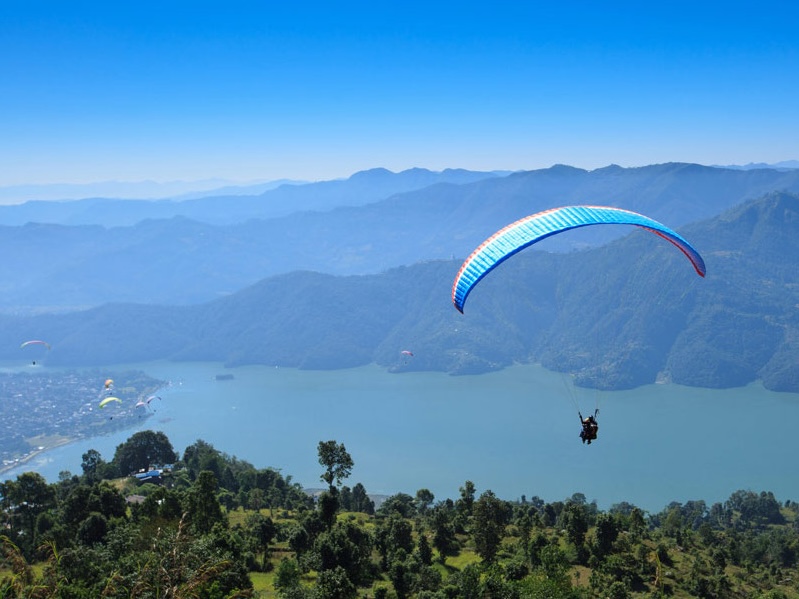
Pokhara – What To Do & See

Everest Base Camp Review

Kilimanjaro vs EBC | Treks Compared | Which is Harder

Is The Maldives Worth It?


