
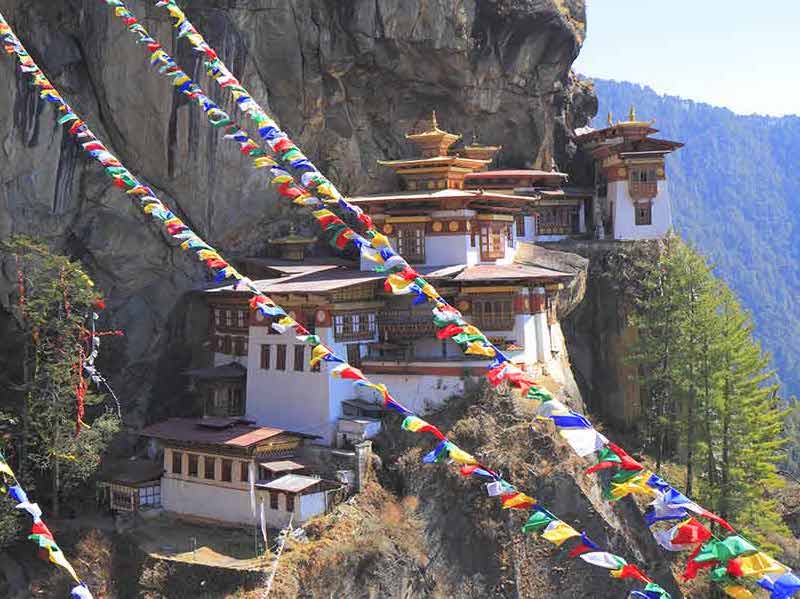
Tigers Nest Tour, Bhutan
6-day tour of Bhutan, including Paro, Thimphu, Punakha, Tigers Nest
Guaranteed departures on ANY dates with just 1 person at the advertised price.
| Group Dates | Land Only |
|---|---|
| 7 - 12 Sep 2026 | £1485 |
| 21 - 26 Sep 2026 | £1485 |
| 5 - 10 Oct 2026 | £1485 |
| 12 - 17 Oct 2026 | £1485 |
| 19 - 24 Apr 2027 | £1485 |
| 27 Apr - 2 May 2027 | £1485 |
| 4 - 9 May 2027 | £1485 |
| 11 - 16 May 2027 | £1485 |
Getting to Bhutan
It is not difficult to get to Bhutan. You need to know:
- How to access the country.
- Where from.
- Then factor in any additional travel time.
Read our article on how to get to Bhutan, or ask us a question.
Reduced SDF Levy Incentive
Bhutan has discounted its Sustainable Development Fee (SDF) by 50% from 1 Sep 2023 – 31 Aug 2027.
- The discounted rate between 1 Sep 2023 – 31 Aug 2027 is $100 per person per night.
- On 1 Sep 2027, the rate reverts to US$200 per person per night.
This discount ONLY applies to the SDF, not the fees for hotels, transport, food or any other services.
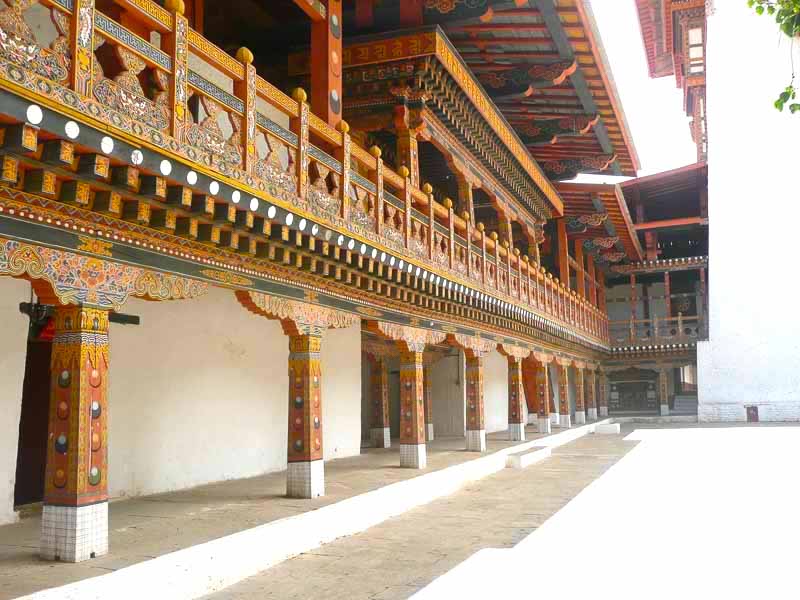
Punakha Dzong, also now utilised as an administration centre for the District.
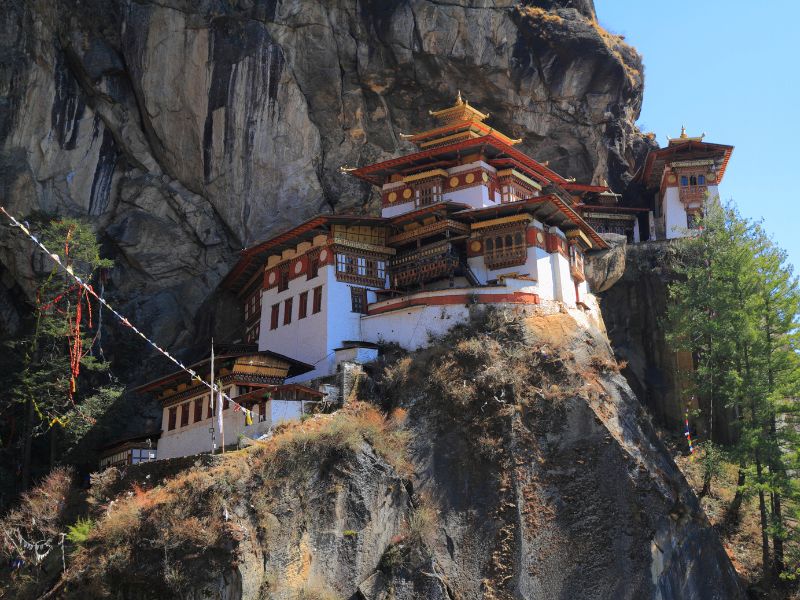
The unmistakable and unmissable Tigers Nest.
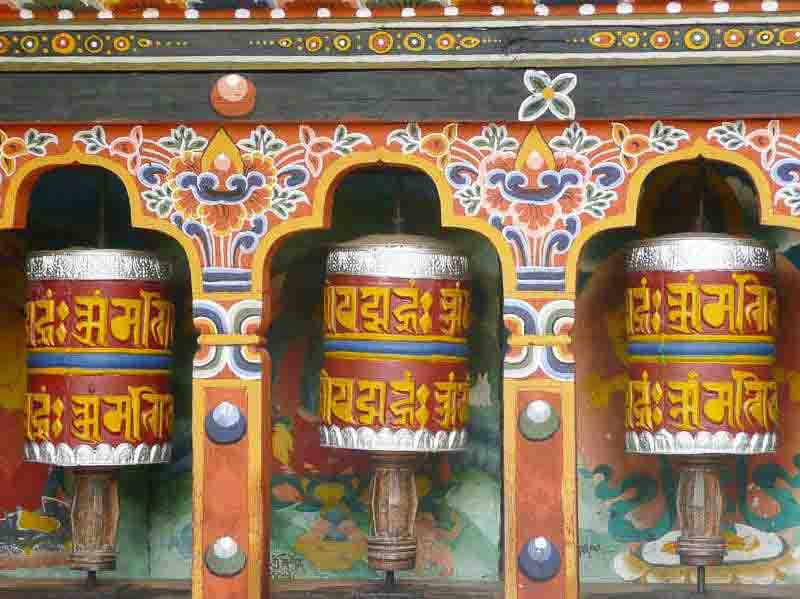
Prayer wheels in Bhutan.
Bhutan Notes
Essential Notes – essential reading on clothing and equipment such as waterproofs, boots, daysack, sleeping bags, travel insurance, travel health and trekking high altitude (opens new tab).
General Notes – covers generic information on our adventures (opens new tab).
With the lowlands and road access in the south (bordering India), rising to the high peaks of the Himalaya in the north (bordering China), Bhutan has diverse geography. Touring (with or without day walks), cycling, trekking (the longer multi-day, higher altitude treks) are all possible here and with the close proximity of Nepal and India, a multi-country itinerary beckons.
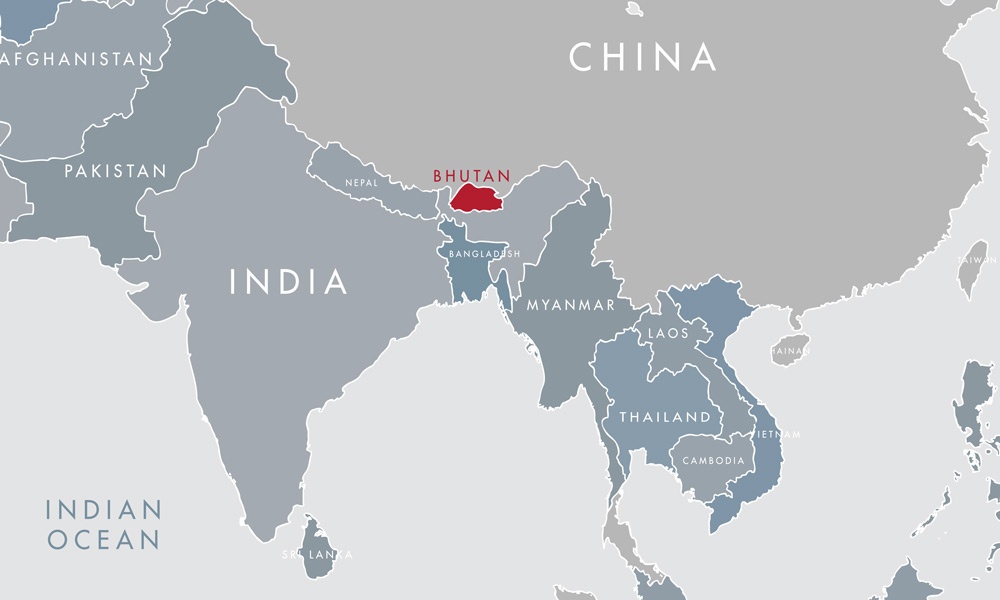
Visa – You will require a visa to enter Bhutan. This must be completed well in advance of travel. The process is completed for you, by us, as an approved Tour Operator. The visa will be sent to you by us, by email. The cost of the visa is included in the price.
Please visit the FCDO Travel Advice Bhutan for the most up-to-date information on entry requirements.
There are a number of ways that you can fly to Bhutan from the UK and therefore it very much depends on your preferred itinerary. See our article on getting to Bhutan from the UK for a wider view of how to access the country. In general terms, from the UK, access to Bhutan is either from Kathmandu or Delhi as they are the closest, most logical, and most convenient locations. From there, you would connect to the Drukair network (Bhutan’s National airline).
One-way flights are possible. For example, inbound Kathmandu – Paro (Bhutan) and then outbound Paro – Delhi, depending on your preferred itinerary.
Drukair is a small airline operating the A319/320 family of aircraft. Flights do not operate daily in every city it serves, and the schedules do change with the seasons. Check Drukair’s schedules on their website once you begin to firm up travel plans. We can assist if required. Seats can be at a premium over peak times (festivals), so early booking is advisable.
Be aware that Paro is situated in a valley at an altitude of 2235m. The landing approach and take-off need to be accurate and the weather needs to be stable. It is subject to delays if the weather is not deemed good enough.
The airline restriction on baggage is the only practical restriction.
If you are touring in Bhutan, the type of luggage you take can be anything you like (suitcase or holdall) as it will be transported by vehicle inside Bhutan.
If you are trekking, you will require a holdall and a daysack.
Daysack – Recommended capacity is 35 litres. The daysack stays with you all of the time when trekking and is likely to contain:
- waterproofs, fleece, duvet jacket, hat/gloves
- water, snacks
- sunhat, sunscreen, sunglasses
- personal hygiene (toilet tissue, hand sanitiser)
- camera
- personal first aid kit
Trek Holdall – A holdall is a soft-skinned bag that will carry the remainder of your clothing/equipment, wash kit and sleeping bag. The holdalls will be carried by the ponies/mules to the next night stop.
Travelling there – Depending on where you are travelling to (and therefore what’s going with you), and how you’re getting there (direct flight or transiting another airport), consider what luggage you use to get your belongings there. The airport baggage handling systems can be rough at times.
Return airport transfers in Bhutan are included. You will be met at the airport on arrival by your Guide and he will be with you until he drops you there for your departure.
If you prefer a bit of luxury, or a treat, you can try one of the higher-class hotels (often called Resorts). Additional fees apply.
On trek, 2-man tents are used.
If your itinerary includes a trek, all meals will be included when trekking, with breakfast and dinners in hotels.
Bhutanese hotels and restaurants tend to work on a buffet-style meal service for breakfast, lunch, and dinner. Any drinks you have (alcoholic or otherwise) must be paid for inside hotels.
Do not drink tap water in Bhutan.
Bhutan is a strongly Buddhist country and therefore they have no slaughterhouses. The meat will therefore be fairly limited on the menu. Any meat that you do see (and fish) is likely to come from India. They eat a lot of vegetables and rice and it can therefore appear a bit repetitive at times.
On trek, your meals will consist of:
- Breakfast – a simple meal consisting of eggs and toast or cereal and a hot drink.
- Lunch – hot and pre-prepared by the chef at breakfast and carried by the Guide is a multi-compartment flask.
- Tea and biscuits on arrival in camp.
- Evening meal – multi-course.
There are no shops when trekking to buy snacks. If you have any preference for chocolate bars, etc.. take them with you.
Catering for vegetarians presents no issues. Most dietary requirements can be catered for if we are aware in advance.
US$ are widely accepted in Bhutan but any change given is likely to be in Nulgrums and the exchange rate certainly in their favour.
Credit cards are accepted in the larger retail establishments and hotels but not in smaller shops. ATM’s are few and far between and are not to be relied upon. We recommend that you carry a credit card with you at all times for emergency purposes. Travel credit cards.
Due to the cost inclusive nature of visiting Bhutan, you will only need to spend money on drinks, souvenirs, and Guide/staff tips. The amount you allocate will depend on your personal spending habits but £300 is not an unreasonable amount to budget for. It is better to take cash.
If you wish to exchange money, your Guide will take you to a bank. Keep receipts when exchanging, you can change any notes back into Sterling or US$ at the airport on exit.
Tipping is the accepted way of saying ‘thank you’ for good service. Tips do not form part of the wages of your staff that you encounter. Remember the Bhutanese are Buddhist; anything they receive will be gratefully accepted from money to a postcard!
Your Guide and driver (if touring) will be with you throughout so they are your prime concerns. If you are trekking, you will have a chef and ‘pony man’ too.
Our advice is to budget for around £20 – £25 per person for the Guide and £10 – £15 for the driver. Any currency will do (especially local) but US$ is preferred if it is to be non-Bhutanese.
In Bhutan, you will be either touring, trekking or a mixture of both.
Even if you are touring, there is a fair amount of walking to be done especially around some of the Dzongs and in particular the Tiger’s Nest. The latter is a stiff 90 min – 2 hr uphill hike to reach the Monastery. There is a half way point (there’s a cafe there) from which you can see the Monastery but if you can go onto the Monastery itself, it is well worth it. It’s a good half day of time.
The trekking routes will require a higher level of fitness in terms of endurance. Fitness is very subjective and in simple terms, train for what you are going to do.
Druk Path – a 5 day route with the first day being the most physical in terms of ascent. Once you get up high though, it’s plain sailing from there. The max altitude is around 4000m. This trek is graded at moderate.
Regardless of what trek you do, expect to be trekking for around 5 – 6 hrs per day, with stops with occasional longer days.
For any advice – call Terry: 07725 943108.
You are strongly advised to read about what Acute Mountain Sickness (AMS, aka altitude sickness) is, be aware of the effects, the symptoms, and what to do if you succumb. Our Essential Information section has more of trekking at high altitude.
If you would rather speak to us for advice, call Terry: 07725 943108.
In general terms, during the main spring and autumn seasons, you will experience a moderately warm environment whilst the sun is up (approx 20°C). As soon as the sun goes down, the temperature will drop quickly.
Shorts/trousers and a T-shirt will be the standard style of dress on a daily basis (when the sun is up) but always carry warmer clothing with you. In the evenings you may require several layers of clothing.
Any trekking usually involves high altitudes and therefore you will require warmer clothing such as a duvet jacket.
Advice for vaccines is constantly developing. Visit your GP and the following UK travel advice website for the most up to date advice and information on where you will be travelling to. Don’t forget to include ALL travel if it includes a wider itinerary.
He will meet you at the airport when you arrive and be with you throughout your time in Bhutan. He is at your disposal. You are encouraged to engage with your Guide as the more he knows you and what you want/like, the more he will be able to assist you and make the most of your time there.
Telephone (landline). Most hotels and many outlets offer international calls at relatively inexpensive rates.
Internet. There are dedicated internet cafes in Paro and Thimpu as well as many hotels. The rates are inexpensive and the connection speed is surprisingly good!
Extensions from Bhutan
Let us help you plan your extended time in Nepal, or beyond. Contact us.

STOPOVER IN KATHMANDU
Transiting Kathmandu? Perfect to extend by a few nights to see the sights.
- Great restaurants, endless shops
- Boudhanath
- Swayambhunah (Monkey Temple)

STOPOVER IN DELHI, SEE TAJ MAHAL
Consider flying into Bhutan via Kathmandu and out via Delhi? It’s easy done and around the same cost. Delhi’s a great city and the Taj Mahal is just a few hours away.
- Arrive in Delhi, drive straight to Taj Mahal (<3 hrs drive)
- Taj Mahal at sunrise – one world icon that lives up to its hype
- See Red Fort, Chandri Chowk, India Gate
All of our holidays can be tailor-made for YOU and we make it simple. It’s so easy to do.
Popular Treks and Cycles

Kilimanjaro, Lemosho

Annapurna Circuit

Ngorongoro Bike Ride, Tanzania

Sahara
Our Reviews
Pokhara – What To Do & See

Everest Base Camp Review

Kilimanjaro vs EBC | Treks Compared | Which is Harder

Is The Maldives Worth It?


