8 Days including 4 Day Trek
High Eclipse Viewling Location
£1090 per person, excl flights
28 Jul – 4 Aug 2027

SOLAR ECLIPSE TOUR TREK
Morocco, 2 August 2027
This an 8-day trip, including a 4-day trek in the Rif Mountains of Morocco to coincide with,
and witness the Total Solar Eclipse from a high, remote isolated location.
Morocco Total Solar Eclipse: 8 days/7 nights
Price from £1090
per person
____________
Deposit £250
Balance due 2 Jun 2027
Sole occupation – £160 (excludes Gites).
Gite sleeping arrangements.
This tour is guaranteed to depart – Max group size 20
Sleeping bag hire – £20 (optional).
____________
Ask a question, or call Terry: 07725 943108
Experience a rare Total Solar Eclipse from a high remote rural location with an unobstructed view of the solar eclipse on our specifically designed trek/tour to coincide with the event taking place on 2 Aug 2027.
Starting and finishing in the ‘white city’ of Tangier, this tour extends to the ‘blue town’ of Chefchaouen before a 4-day trek through the Rif Mountains, to the Mediterranean coast.
Arriving in the historic, bustling port city of Tangier (by air or sea), there is an overnight here, perhaps time to explore its rich multicultural heritage, blending Moroccan, Spanish, and French influences across its historic medina. The tour moves onto the ‘blue washed’ town of Chefchaouen nestled in the Rif Mountains. It is a photographer’s dream. Wander its maze of cobalt alleyways, artisan shops and quiet squares, where mountain air, slow rhythms and striking colour create one of North Africa’s most enchanting escapes.
It is from Chefchaouen that the 4-day trek begins, which includes the Total Solar Eclipse.
This undulating trek utilises the traditional and hospitable mountain gites, meandering its way northwards through very diverse, beautiful countryside. With ascents of between 600 – 800m on 3 of the 4 days, there is some trekking to be done so you’ll earn your rest each night! It ends on the beautiful Mediterranean coast. You are supported by a Guide and a back up crew to transport luggage.
There is ample time to explore the two main urban areas of Tangier and Chefchaouen and if you wish to extend your time in Morocco, please let us know and we can adjust as required.
On the morning of the Total Solar Eclipse, we rise early to enable a leisurely ascent to our pre-planned remote location. Enjoy this rare event with some eclipse protective glasses are supplied.
Sole Occupation & Gite Sleeping Arrangements
Sole occupation includes the occupation of a single room in hotels/Riads (Tangier (2 nts), Chefchaouen (1 nt), Oued Laou (1 nt)).
This does not include the mountain Gites.
If chosen, £40 is payable with the deposit, the remaining £120 at the final balance stage (total £160).
Gite Sleeping Arrangements. By their very nature, Gites are community based establishments. In general terms, the Gites will have the following:
- Shared twin rooms
- Twin/double rooms for couples
- Triple and quad rooms (same sex)
Reserving a specific room is not possible. Until the group is fully formed we will not know how it’s made up.
Common sense will apply when allocating rooms at each Gite.
Showers and toilets are available, all shared use.
Sleeping Bag Hire
A sleeping bag is required for the 3 nights in gites. You can take your own or hire one of our freshly laundered bags for the duration of the trek. It saves carrying such a potentially bulky and weighty item throughout your journey (unless you need it for a wider itinerary).
28 Jul 2027 – Arrive Tangiers, overnight
29 Jul – Tangiers to Chefchaouen
30 Jul – Chefchaouen – Affaska
31 Jul – Affaska – Akshour
1 Aug – Akshour – Talambote – Beni Malaa
2 Aug – Beni Malaa – Oued Laou
3 Aug – Transfer to Tangiers
4 Aug – Depart
What the Price Includes
- Return transfers from Tangier airport or harbour
- All accommodation, twin share basis
- An experienced, licenced English speaking local Guide
- Luggage porterage
- All land transfers involved in the itinerary
What the Price Does Not Include
- International flights
- Travel insurance (compulsory)
- Meals not stated in the itinerary
- Optional trips and sightseeing tours not stated in the itinerary
- Guide and Crew gratuities
What is a Total Solar Eclipse
A Total Solar Eclipse occurs when the Moon completely covers the Sun, as seen from Earth. This Total Solar Eclipse’s totality will be the longest on land since 1991 (max >6 mins). How an Eclipse unfolds.
Totality in our location in Morocco – 4 mins 41 secs.
Partial solar eclipse starts – 0840 hrs
Start of totality – 0945 hrs
Finish totality – 0950 hrs
Partial solar eclipse ends – 1101 hrs
The next total solar eclipse in Morocco is on 12 Sep 2053!

How a Total Solar Eclipse Unfolds
A Total Solar Eclipse unfolds in 5 distinct phases:
1. Partial Eclipse (First Contact)
The Moon begins to move across the Sun, taking a small ‘bite’ out of it (first contact). The light gradually dims, though it still feels like daytime.
2. Pre-Totality
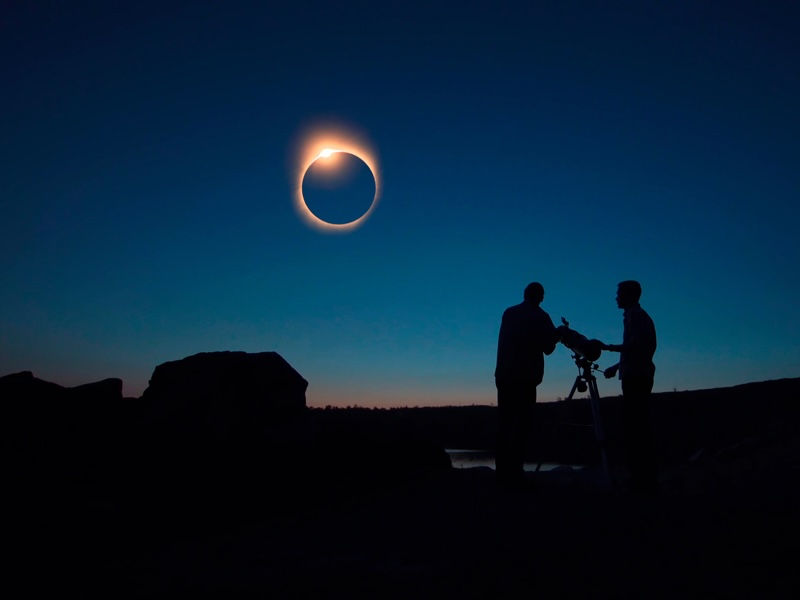
The moments immediately before totality. As the moon’s coverage increases across the sun, daylight takes on an eerie still quality. Shadows sharpen, temperatures drop, and you may see ‘crescent’ sunlight patterns on the ground. Little bright beads of light appear around the moon’s edge (Baily’s beads). As the beads fade, one final, brilliant point of light remains, resembling a sparkling diamond ring alongside the Sun’s visible outer atmosphere (the corona).
3. Totality
The Moon completely covers the Sun. The sky darkens dramatically, stars may appear, and the Sun’s outer atmosphere – the corona – becomes visible. This is the only phase safe to view without eye protection.
4. Partial Eclipse
A reverse of pre-totality, as the diamond ring and Baily’s beads reappear.
5. Partial Eclipse (Final Phase)
The Moon moves away, sunlight returns, and normal daylight resumes.
A Cosmic Marvel
- A Total Solar Eclipse is a cosmic marvel as described by the Royal Museums Greenwich.
- The Sun is 400 times larger than the Moon and yet, during a Total Solar Eclipse, it visually covers it entirely.
- How? Coincidentally, the Sun is 400 times further away from the earth so when they align, they appear the same size.
- Baily’s beads – about 15 secs before totality (and after), specks of light appear around the dark side of the moon like ‘a string of pearls’.
- Diamond Ring – lasting just 3 – 4 secs, a dazzling jewel shines bright like a diamoind ring in the immediate moments before and after totality.
The National Eclipse is another excellent resource the all things Solar Eclipses.

Trip Notes
IMPORTANT – you are strongly advised to carry your passport with you whilst in the mountains. Checks by the authorities may be carried out and failure to produce identity documents may lead to issues.
Download the kit list – Total Solar Eclipse
Waterproofs – it’s Aug, in northern Morocco, the temperatures will be hot (30+°C). But in the mountains, despite the dry months it can still rain, and when it does it can rain hard. However unlikely that is, please ensure that you have a decent waterproof jacket with you, one that can withstand a downpour.
Footwear – Good comfortable footwear is essential on this trip, there’s a good amount of walking!
Our recommendation in any mountain terrain is boots. They provide the essential ankle protection and solid non-slip sole required in uneven, sometimes rocky terrain like this. A summer 2-season (waterproof) boot is sufficient for this.
As tempting it is to use a trail shoe or trainers, there is a much higher risk of an ankle twist, or break, or slip causing other injuries.
Daypacks – You need a comfortable daysack capable of taking all that you will need from one accommodation to the next. That includes water (temperatures could be high), snacks, clothing (such as sun hats), and other equipment such as sunscreen, first aid kits, sunglasses, phones, etc. If you are well organised, daypacks for this 4 day trek do not have to be big, just ‘fit for purpose’. Read our comprehensive article on how to choose a daypack, what ‘fit for purpose’ means, what to consider (including capacity), and links to the main manufacturers, as well as whether it may be better to hire.
Sleeping Bags (+hire) – You will need a sleeping bag for the 3 nights that you are staying in the mountain gites. If you wish, for your convenience, you can hire a sleeping bag from us for £20 for the trek. It saves carrying such a potentially bulky and weighty item.
Passports & Visas – For up-to-date information on entry requirements into Morocco, please visit the FCDO Travel Advice webpage for Morocco.
IMPORTANT – you are strongly advised to carry your passport with you whilst in the mountains. Checks by the authorities are being carried out and failure to produce identity documents may lead to issues.
You Cannot Afford To Travel Without Travel Insurance – Simple
Travel insurance should be considered an integral part of your trip costs. Accidents can happen to anyone at any time.
Take a look at some of our personal experience case studies.
Our Personal Experience Of Travel Insurance Claims
A back injury whilst trekking in Bhutan – helicopter evacuation, estimated cost in excess of £15,000.
A client with High Altitude Cerebal Endima (Everest Region), helivac’d and hospitalised in Kathmandu for 1 week. Released back to UK under Para Medic escort (flown in from UK). Estimated cost in excess of £20,000.
Client gastro problem in Morocco, hospitalised for 3 days (Marrakech), change of flights, etc.. estimated cost £2500.
Remember … it’s not just the cost of any form of evacuation. It’s the cost of all services associated with leaving the scheduled itinerary such as accommodation, the cost of additional manpower to escort you, transport and food plus the medical expenses.
Take a moment to consider how a simple accident can cost upwards of £10,000 and how long that would take to pay off if you had to do it from your own pocket? All for the sake of saving around £100 for the cost of an adequate travel insurance policy. It’s simply not worth the risk.
TIP! As soon as you book any trip, investigate, decide and buy your travel insurance.
Why? Because even half decent policies will cover you for cancellation of your trip from the date of purchase, not just the period of your cover.
To be adequate, your policy MUST cover you for:
- Medical emergencies including rescue and repatriation to UK.
- All activities you will be undertaking.
Some advice…
- Missed departure – make sure this section covers the cost of a one way flight home. If it doesn’t, consider increasing it, using a policy that does or be prepared to pay the extra!
- Most travel insurance companies use a ‘pay and claim’ system. Carry a credit card with adequate funding capacity for emergencies.
- If you need to claim – call your insurance company immediately (or as soon as possible; don’t delay). They will give you advice. Check phone calls are a claimable cost. Keep all paperwork and receipts related to the claim, take photos if appropriate, videos/images of delayed flight information, etc…you are highly likely to need them to support any claim.
- Purchase your insurance policy as soon as you can after booking a trip. Policies should cover you for cancellation of your trip prior to departure due to injury or illness.
- Travelling more than once in a year? Consider an annual policy; usually cheaper.
- Check policies you may have with banks or building societies; some are not geared for adventure travel.
Here are some companies that some of our previous clients have used before and found their cover to be adequate for their needs. Make sure that you check the policies yourself for what YOU want it for:
True Traveller
Easy site to use, set up by travellers and a good place to start.
Add sections onto the policy, step by step, and see the premium change as you do.
Adventure Pack and Extreme Adventure Pack cover just about anything you need for our trips.
The annual multi-trip policy is excellent value; worth a look if you’re likely to travel twice in a 12-month period.
You don’t have to be a Doctor or medical professional to be well prepared medically for an adventure.
Nothing will spoil your trip more than having health problems. With just a little thought about what might happen and together with knowledge of your own body, it should be sufficient for you to prepare a decent personal First Aid kit.
Quick checklist:
- Adequate travel insurance
- A personal First Aid kit (see below)
- Up to date and appropriate vaccinations for your trip (see below).
- A dental check up prior to travel.
Food hygiene standards in third world countries are less than what you are used to; a change of bowel movement is likely! The question is, to what degree! Travellers’ diarrhoea is very common so be ready for it! Read more about traveller’s diarrhoea.
Vaccinations
Make sure you’re up to date with both the UK citizen childhood NHS vaccination schedule and what you are recommended to have for your destination. Some travel vaccinations can be obtained on the NHS FREE of charge, others will be chargeable.
There are no vaccines for Malaria; tablets. Seek advice as what is prescribed very much depends on where you are going (and in some cases the region of that country). Preventative medicine for Malaria is constantly changing.
The following websites are excellent references to ascertain, or confirm, what is recommended for each country.
Travel Health Pro – All things travel health
Travel Doctor Vaccines (UK)
Personal First Aid Kit
This is a suggested list of what you might consider carrying. It is not exhaustive. Build your own by adapting it to your own wishes/needs.
- Zovirax, cold sores
- Lip balm, preferably sun protective
- Steristrips
- Crepe bandage
- Vaseline
- Safety pins
- Cold/Flu capsules
- Imodium, diarrhoea
- Strepsils or similar, throats
- Ibuprofen, pain inflammation
- Paracetamol, pain killer/headache
- Asprin, sore throat/various
- Dioralyte, dehydration
- Gaviscon, indigestion
- Insect repellent
- Zinc oxide tape, for blisters
- Compede, for blisters
- Melonin Pads for injuries
- Diamox, related to high altitude (see High Altitude tab)
We do not include or sell international flights. There are a plethora of flights, primarily low-cost airlines, that fly to Tangier from London (Gatwick and Stansted), and also from Manchester (limited).
Casablanca and Marrakech offer a wider choice if either of those destinations feature in your wider itinerary.
At least 2 pieces of luggage will be required on this Total Solar Eclipse trip; a daysack and a ‘main bag’.
Daypack – As shown under the ‘Kit List, Clothing & Equipment’ tab above.
Main Bag – this will carry the remainder of your clothing/equipment. This bag will be transported from night stop to night stop by vehicle so it doesn’t matter what type of bag it is. It can be a holdall, suitcase, or similar.
Airport or Harbour transfers are included if you arrive and depart on the scheduled itinerary. Additional charges may apply if you are extending beyond the scheduled itinerary. We will inform you of any additional charges prior to booking.
Tangier – The Dar El Kasbah or similar.
Chefchaouen – Riad Cherifa or similar.
Mountain Gites – Tradition Gites along the mountain trail.
Note that sole occupation (single rooms) are not possible in the Gites.
Single room option costs £180 and excludes the 3 nights in Gites.
If requested, it includes the occupation of a single room in hotels/Riads (Tangier (2 nts), Chefchaouen (1 nt), Oued Laou (1 nt)).
Hotels/Riads – Unless otherwise stated in your itinerary, all hotel/Riad accommodation is based on a B&B basis allowing you to roam and discover the vast array of amazing restaurants from traditional Moroccan cuisine to pizza houses, from late-night bars to quiet coffee shops.
Breakfasts usually are buffet style consisting of fruit, cereals, hot food, pastries, fruit juices, and hot drinks.
On trek, all meals are supplied when trekking. There are no (or few) resupply facilities on the trek. Any preferred snacks such as energy bars must be purchased and taken with you. Please do bear in mind the potential heat when choosing your snacks (eg chocolate melts!).
To give you an idea of the food choices on trek:
Breakfasts are continental style consisting of cereals (including porridge), bread with various spreads (jam, honey, nutella), cream cheeses, omelettes, hot drinks. The content will vary daily.
Mid-morning Snacks in the form of a big bag of mixed nuts and fruit are also often provided, magically appearing from the Guide! This mix consists of dried figs and dates, sugar coasted nuts, and more nuts of all sorts.
Lunches are freshly prepared and can range from salad with tinned fish, bread, olives, cheeses, and some fresh fruit. Hot meals can also be served, often lentils or similar.
Evening meals consist of 3 courses: soup, main course, and dessert.
Starter – various soups with bread.
Main course – traditional tagines of chicken, lots of vegetables, rice, lentils, pasta, and similar hearty dishes.
Desserts – normally tinned fruit.
Hot drinks.
Most dietary requirements can be catered for. We will take the requirement from your booking form.
Drinking Water
The purchase of drinking water is your responsibility throughout this tour. It is inexpensive, and widely available. If required, your guide will show you where to buy it but in general terms, plan ahead to ensure that you have enough.
The local currency is the Moroccan Dirham (MAD). You may find it difficult to obtain local currency before you arrive in the country.
Tangier and Chefchaouen will certainly takes cards but you will need some MAD cash for very local shops, and some staff tipping.
Be wary of when the official Money Changers are open, it may be best to exchange cash initially at the airport on arrival to avoid being caught out.
The Medina is a great place to shop. The traders in there are excellent bargainers. Know your prices and bargain hard!
We recommend that you carry a credit card with you at all times for emergency purposes. Travel credit cards.
Money – Guidance on Tipping
Tipping is the accepted way of saying ‘thank you’ for good service. Tips do not form part of the wages of your guides and trek crew but they are very much appreciated. It is important to remember that tipping is voluntary and should be dependent on good service. Normally the tips are given at the end of the tour/trek and this is best done as a group.
Our advice is to budget between £30 – £40 per trekker (in local currency). Nominate a group representative to collect the tips and present them to each individual rather than giving to the Guide to distribute as this is far more personal. This is normally done as you reach the end of the tour.
Fitness is very subjective and in simple terms, train for what you are going to do.
This 4-day trek in the Rif Mountains of Morocco are moderately challenging. And traditional weather patterns dictate that it will be hot and dry.
Daily trekking times are between 5 – 7 hrs, with rest stops. Daily ascents are between 600 – 800m.
On Solar Eclipse day, add another few hundred metres of ascent plus 3 hrs.
There is nothing on this trek that is massively demanding. It is undulating using well used and worn mountain tracks.
We recommend adopting a regular training regime on the lead up to your trip as the fitter you are, the more you will enjoy it. Most averagely fit people should have no problem completing this trek.
For any advice – call 01529 488159 or 07725 943108.
Jul and Aug are northern Morocco’s hottest and driest months. Daytime temperatures can easily reach 30° – 36°C.
Rain is usually negligible.
In the Rif mountains, while the air may be cooler, it will still be hot.
With luck, the cloud will not show itself for one of nature’s greatest spectacles – a Total Solar Eclipse.
Medical – Vaccinations
Advice for vaccines is constantly developing. Visit your GP and the following UK travel advice website for the most up to date advice and information on where you will be travelling to. Don’t forget to include ALL travel if it includes a wider itinerary.
On this tour/trek, you will have an experienced English speaking Moroccan guide, a driver and a chef. The latter two may combine depending on group numbers. They are your first point of contact for anything you may need. Engage with them early for they will enjoy the social interaction.
Morocco has generally good mobile coverage. On the trek, coverage is there but you may hit the odd black spot. It will very much depend on exactly where you are and your network.
Morocco has a standard European 220v, 50Hz supply.
The round European 2 pin plugs are used. World power and plugs – see what works
Ideas To Enjoy Morocco

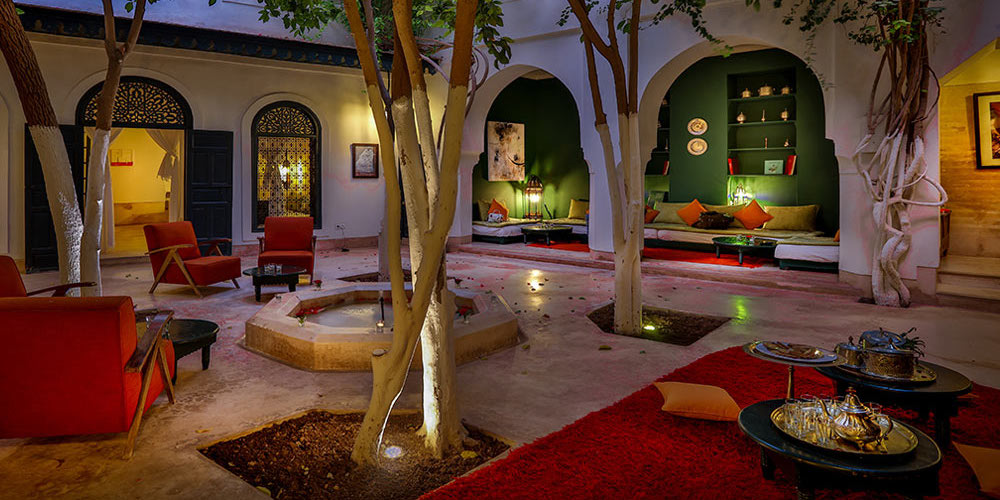
LUXURY RIAD
Treat yourself to a night or two in a hidden luxury traditional Riad. They are beautiful establishments, peaceful, and often locked deep away inside the Medina. A good base from which to explore.
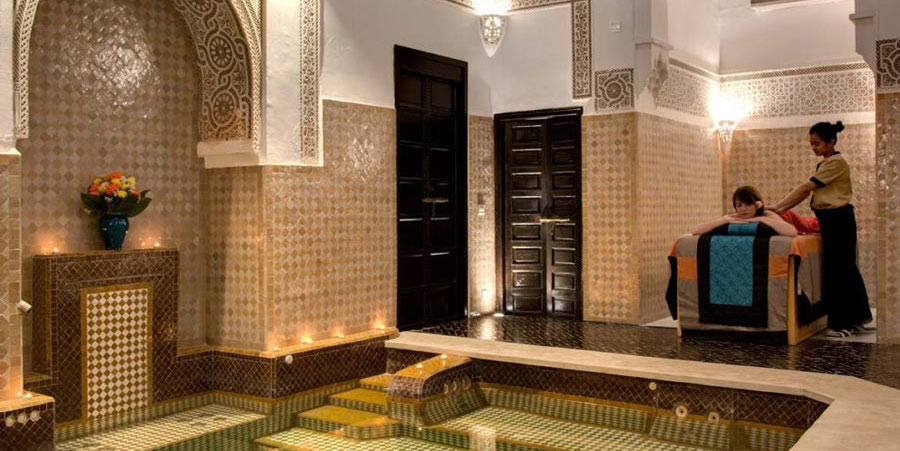
ENJOY A SPA OR HAMMAM
Relax in a traditional Hammam. These can be associated with your hotel/Riad, or you can book another outside. Either way, booking in advance is recommended to ensure your day is planned as you like it.
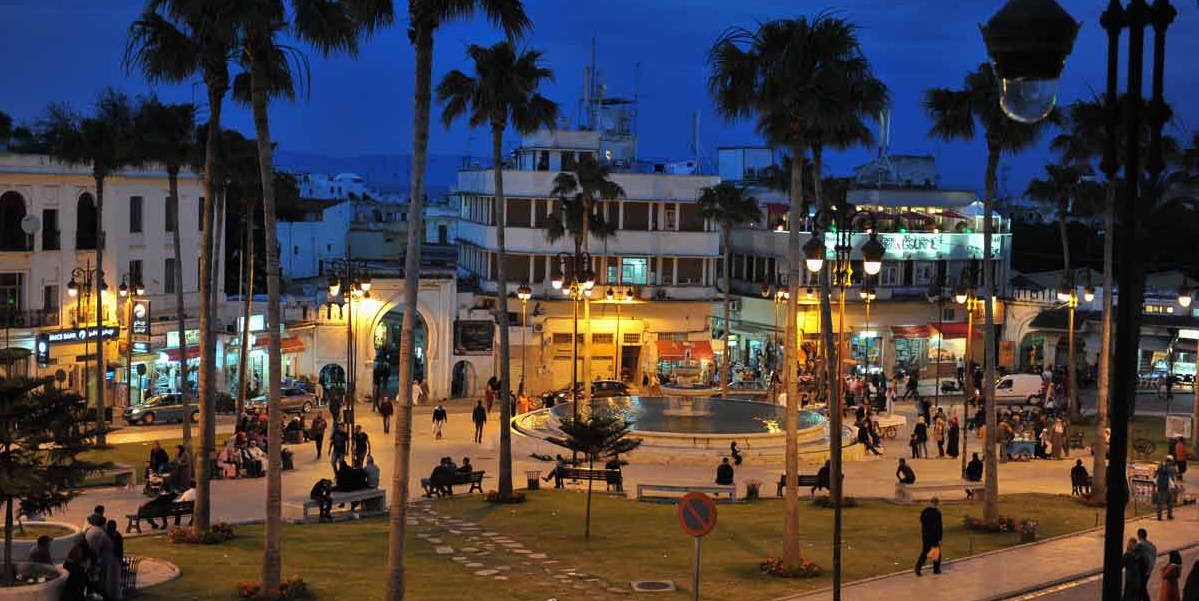
GRAND SOCCO TANGIER
Tucked in the historic part of Tangier, the Grand Socco is a lively square leading to the labyrinth of streets in the adjoining Medina. It’s possible to spend hours wandering in this area.