
Flights to Kilimanjaro – from the UK
What are the flight route, airline, and airport options to Kilimanjaro from the UK?
This post examines the 3 prime routes to Kilimanjaro’s International Airport (code JRO) from the UK. There are currently no direct flights (see below). All flights have at least 1 stop. These routes will get you to JRO comfortably in under 15hrs from departure to arrival.
The 3 main hubs are Doha (Qatar), Nairobi (Kenya), and Amsterdam (Holland).
Clearly with the ongoing situation in the Middle East, flights through Doha are being affected. As at 31 Jul 2026, they were operating an almost full schedule but this can change at any time. Refer to Qatar Airway’s website for up to date information.
* It is reported that Air Tanzania is to commence direct flights from London Gatwick (LGW) to JRO mid 2027.
Flying UK – Kilimanjaro
What are the route, airline, and airport options from the UK to Kilimanjaro, Tanzania?
This post examines the 3 prime routes from the UK to Kilimanjaro’s International Airport (code JRO). All of them require one stop. There are no direct flights. These routes will get you to JRO comfortably in under 15hrs from departure to arrival. The 3 main hubs are Doha (Qatar), Nairobi (Kenya), and Amsterdam (Holland).
Clearly with the ongoing situation in the Middle East, flights through Doha are being severely affected. But they are operating. As at today (12 Apr), Qatar appears to be operating up to 4 flights per day between London Heathrow (LHR) and Doha (DOH), which is around 50% of the usual schedule. Flights to/from Gatwick are due to commence on 16 May according to Qatar’s website.
Tanzania is only GMT +2 hrs so with a 13 – 15 hrs flight time, it is possible to fly in both directions in a single day BUT only KLM do this, and timings are not good! The vast majority of flights in both directions are overnight.
In considering your choice, several factors can have a significant effect on your journey, both positive and negative, so it is worthwhile giving them some thought.
- The airline (reliability and quality) and aircraft type
- The route
- Flying time (overall time between departure and arriving in Kilimanjaro)
- Stop over time (time spent in the interim airport)
- Who do you book with (direct with the airline, or an agent)
- Cost
- Departure/arrival times
- Interim airport (quality of)
The 3 main routes from the UK – Kilimanjaro.
Click image to enlarge

Why Go?
The adventures of course! Apart from the obvious and ever-present Mt Kilimanjaro climbs (4 different routes), we offer a whole range of alternative adventures for solos, through to families. Try Mt Meru (please ask for details), the excellent Kili-Ngorongoro cycle ride (the e-bikes are brilliant), the Kilimanjaro 360 cycle, the Highlands trek, and anything in between with a whole load of safari and Zanzibar extensions.
Let us build your own adventure – enquire here.
The Main Airlines
Qatar Airways, British Airways, Kenya Airways, and KLM are the airlines that are most prominent on the routes offered. Qatar (codeshare with British Airways) will offer the greatest number of departure airports within the UK (Heathrow, Gatwick, Manchester, Edinburgh, and Birmingham) as they all fly to Doha, where the onward leg is picked up. Kenya Airways fly from London as does KLM and British Airways. London Heathrow has the greatest number of options.
Other routes and airlines are available although untested by us. Ethiopia Airlines via Addis Ababa operates what looks like a decent set of flying and stop-over timings. Although Turkish Airlines via Istanbul operate the route, it appears sporadic.
Aircraft Type – It’s Time To Know Your Aircraft
This may be considered boring stuff but this short section could make a difference in the comfort of your flight. The aim here is to easily identify a short-haul aircraft from a long-haul aircraft as the difference inside them (comfort-wise) is potentially huge.
An easy way to identify short-haul aircraft is to think of low-cost airlines such as Ryanair and EasyJet. They fly the Boeing 737s (Ryanair) and the Airbus 320/321 (EasyJet). Their seating plans are 3 seats on either side of a single aisle (3 x 3).
Compare those to the huge double-decker A380s, the wide-bodied A330, or the 777 family. These aircraft are all designed for long-haul flights with seating plans to match such as 3 x 4 x 3 across (twin-aisle) and therefore tend to be roomier in certain parts of the aircraft. The galley area and toilets are examples. Seat pitch (legroom) is likely to be more generous given what these aircraft are built for.
There are pros and cons to aircraft type but it is useful to know what you’re flying on and if you have any experience with them, it’s easier to make an informed decision. The aircraft type will always be stated with the flight itinerary even with flight search engines.
The long-haul aircraft will have options for premium economy and business class seats. Whilst the short-haul aircraft do have business class seats, the product does not compare with the larger aircraft.
Flying through Doha (Qatar Airways)
Qatar Airways is undoubtedly one of the best airlines in the sky. They have frequent daily flights from London (Heathrow and Gatwick) as well as departures from Manchester, Edinburgh, and Birmingham. Qatar Airways codeshares with British Airways, so you can book through British Airways, but the vast majority of the flights will be operated by Qatar Airways.
Qatar Airways operates a modern fleet of aircraft from the big double-decker 380 to the 350 and 777’s too. The 380 only operates from Heathrow. These aircraft will operate to Doha with the smaller capacity 320 or 330 aircraft, taking over to Kathmandu. Be aware that some Qatar flights will go through Dar El Salam for a short stop.
Doha is Qatar’s modern and efficient airport hub. This is one hub I would trust with a short transfer.
In my view, under normal circumstances, I would look no further than Qatar Airways, but their return journeys appear to be extremely long at the time of writing.

Flying through Nairobi (Kenya Airways/British Airways)
British Airways (A350) and Kenya Airways (787) both operate a daily flight to Nairobi from Heathrow. From Nairobi, it is just a 1 hr flight with either Precision Air (a subsidiary of Kenya Airways) or Kenya Airways themselves into Kilimanjaro International.
The only downside is Nairobi’s airport itself. It’s an aging airport and not the most efficient but ultimately it works. When boarding Precision Air to Kilimanjaro International, for example, it is often the case that you have to collect your Boarding Pass at a counter in Nairobi. This can be fraught with queues, and wondering if you’ll ever make the flight.
In the opposite direction, it’s fine. The good news about this short flight is that weather permitting, you should be able to see Mt Kilimanjaro from the air quite easily.

Flying through Amsterdam (KLM)
The good news about flying with KLM is that you are connecting through a European hub. With that (as opposed to Nairobi or Addis Ababa (Ethiopia)) you know that they will be an element of efficiency and should there be any issues, you have the protection of EU law (flight compensation for example). Once you have flown into Amsterdam’s Schiphol Airport (AMS), the flight to Kilimanjaro is direct.
KLM uses the 737s from London to Amsterdam and then the larger 787s to Kilimanjaro International. Be aware that KLM uses both Heathrow and London City airports.
Depending on the dates flown, KLM’s flying times can be very quick.
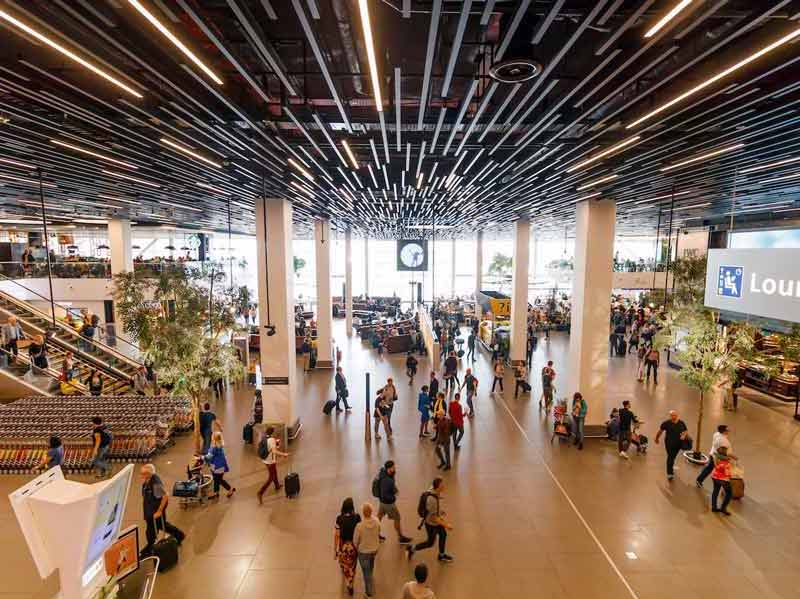
KLM’s transfer times in Amsterdam do tend to be short!
Arusha Airport – Don’t Be Confused!
Arusha has two airports. Kilimanjaro International (code JRO) is often referred to as Arusha Airport, which can be confusing given that the domestic airport just down the road is also called Arusha Airport (code ARK). You will see the code ARK come up in some search engines, which in theory means the flight’s destination is the domestic airport. The ARK airport is not capable of taking large aircraft, so there is an anomaly there somewhere. Even if you did, the distance between them is not great.
The message is to be aware of the anomaly and if you are flying into Tanzania on an international flight, you will land at JRO.
Who to book with?
It’s understandable that most people use search engines to find the cheapest flights, which is subsequently through a 3rd party agent. The agents are often cheaper than the airline itself but be aware of the downside should something go wrong! There are dozens of these agents to choose from, many of which are owned by the same companies. Expedia for example owns ebookers, cheaptickets, Orbitz, and more.
The percentage of flight journeys that are cancelled or have some form of major disruption that would cause harm to your holiday itinerary is quite small given the number of daily departures worldwide. You may, therefore, be considered unlucky should that happen. But should it do so, it’s what happens next that is of concern.
If you book direct with an airline, that has a UK office (Qatar or British Airways for example), you can contact them and sort out any issues relatively easily. Any fees, should they be due, will be singular (just payable to the airline) and straightforward.
If you book with an agent, you are adding a 3rd party to the communication chain and it can become cumbersome, expensive, and potentially disastrous if the agent’s terms are not in your favour! What an agent may deem as a cancellation, an airline itself may not. It can be extremely difficult to contact some agents, and they then, need to contact the airline. Sometimes this is not automated. Should fees be involved at all, the agent will charge a fee, in addition to the airlines fee. You are paying twice.
I emphasise that the risk of such issues occurring may be small, but it is still a risk.
Warning … as an example, you can book flights with the popular search engine booking.com, usually more associated with accommodation bookings. Their terms clearly state that they are acting on behalf of another 3rd party agent and assume no responsibility whatsoever. They are merely passing it on. In that scenario, you have at least 3 entities involved: booking.com, the agent, and then the airline. All will charge fees if there are changes or cancellations involved.

There are dozens of online agents vying for your business. They may offer cheaper flights but should changes be needed, their fees may sting!
Booking direct with airlines, although perhaps more expensive, is more simplistic and eliminates any risk with online agents.
Where to Search?
Flight search engines are excellent to get an overall picture of what’s on offer. The price, the airline, the timings, stopovers, etc… You want one with decent filters to allow you to narrow down your search with the minimum of fuss, adverts, or attempts to direct you elsewhere! Once you have identified your preferred flights, you can choose where you book from (agent or airline direct). Whatever you do, before you decide who you book with, check their terms for changes and cancellations.
Kayak is good, and they also manage Momondo, which provides some interesting insights too (worth a look).
Flying Time, Stopovers, Sleeping Pods and Departure/Arrival Times
Flying Time. Anywhere between 13 – 15 hrs I would suggest is your window. The shortest flights are through Nairobi and Amsterdam as geographically, it is very direct.
Stopovers. Anything less than 90 mins to change flights is going to be tight. Some airlines/airports are more efficient at these changes. I would certainly trust a short change in Doha over Nairobi for example. It is to be remembered that it is the airline’s responsibility to get you to the destination so it is in their interest to get you on board that connecting flight. Some travellers like to spend some time in the interim airports to have a break from the journey, so where it is possible, you can opt for a longer stopover.
Sleep and Fly. Doha offers properly kitted-out comfortable rooms (single, double or family rooms) within the airport, within transit. Sleep ‘n fly is the place to go for Doha. Don’t discount this option as a longer stopover may invite cheaper fares, which when you add the cost of the airport room, may still be cheaper than the higher priced faster flights.
Departure & Arrival Times. There is a welcomed variety of departure times from both ends, which clearly affects when you arrive at your destination. Not all airlines offer the same variety so check around them to see what suits you best.
Arriving in Kilimanjaro. Thankfully Kilimanjaro is not a very busy airport so it doesn’t take too long to clear it and be on your way. With the small time difference, jetlag is not an issue either so adjustment is relatively easy. The timing of your arrival is therefore not critical.
Departing Kilimanjaro. Very early morning departures usually get you back to the UK on the same day, arriving late evening. If that causes a transport issue in the UK (late arrival), then an afternoon or evening departure will get you back into the UK early the next morning.
Multi-Airport Flights (Extensions to Zanzibar)
Extensions to Zanzibar. It is not uncommon to take advantage of Zanzibar’s close proximity and spend a few days relaxing on the island’s glorious white sandy beaches (pictured). This can often make international flights easier than a return ticket London – JRO. Instead of a return ticket to JRO, it becomes a ‘Multi ticket’ from London – JRO and then Zanzibar (ZNZ) – London. The cost of such a ticket is often the same or very close to a return ticket.
The domestic 1 hr flight between JRO and ZNZ is best booked separately. Precision Air (recommended) and Air Tanzania are the two main carriers. Both operate turbo-prop aircraft.

Summary
All of these routes operate on a daily basis, most without incident. Cost is a significant factor and it is a case of assessing the risks (airline and airports) and deciding if you are willing to accept the consequences should something go wrong. Travel insurance protection is a wonderful, and necessary, thing but ultimately it is best to avoid any unnecessary risk in the first place.
Read our other articles on ‘flying to Marrakech‘ and ‘flying to Kathmandu‘.
Related Posts

Best route to fly UK to Kathmandu

Best route to fly UK to Kilimanjaro

Best route to fly UK to Marrakech

Underseat Bag Boom


